


Views: 0 Author: Site Editor Publish Time: 2026-06-01 Origin: Site


Off-season training often frustrates dedicated players. You face two difficult choices during winter months. You brave freezing temperatures on outdoor courts. Or, you rely on a traditional ball machine indoors. The latter usually requires a full-size indoor court. It also provides zero analytical feedback regarding your performance. You just hit balls into empty space.
Enter the modern Tennis Simulator. This impressive technology changes the training landscape completely. It bridges the massive gap between recreational indoor golf setups and professional tennis analytics. It brings viable, year-round training right into your home.
High-end setups can replicate blazing-fast professional serves. However, they cannot perfectly replace the physical vibration of a heavy baseline rally. No digital system currently achieves perfect on-court realism. Instead, their true value lies elsewhere. They allow focused mechanical repetition. They improve rapid decision-making. They ensure year-round accessibility regardless of local weather. We will explore spatial requirements, tracking technologies, and how to choose the right system for your home.
Space is the ultimate dealbreaker: A true physical simulator requires a minimum of 16'(W) x 20'(L) x 10'(H) to function safely.
Physical vs. Virtual: Pure VR headsets lack physical racket feedback; serious mechanical training requires physical simulator enclosures with impact screens and custom ball machines.
Metrics that Matter: Professional-grade setups must track speed, spin rate, trajectory, and bounce point using photometric cameras or radar.
Define your baseline immediately. We must filter options based on your spatial realities. You have two main distinct paths. You can choose a purely virtual setup. Alternatively, you can install a physical enclosure. Both serve very different training goals.
Virtual reality offers a very low barrier to entry. It requires minimal physical space inside your home. You only need enough room to swing a handheld controller safely. VR excels at basic visual reaction timing. You can practice reading a server's toss motion. You can improve your split-step timing.
However, VR carries significant mechanical drawbacks. It suffers from the famous "ghost handshake" effect. You swing your controller, but you hit nothing. You receive zero physical kinetic feedback upon impact. You cannot practice true sweet-spot striking. You cannot feel string tension reactions upon ball contact. This severely limits its use for serious mechanical training. Your body might develop unnatural swing paths. You stop bracing for actual physical impact.
A physical Tennis Simulator offers a completely different reality. It combines motorized ball machines, durable impact screens, and advanced tracking sensors. You hit real tennis balls. You use your own actual racket. This combination provides highly realistic kinetic feedback. You feel the physical impact. You know instantly if you mishit the ball off the frame.
The main downside remains quite obvious. A physical system requires dedicated real estate. You must dedicate a large portion of a basement or garage. It demands serious structural planning. You cannot simply fold it away after a quick session.
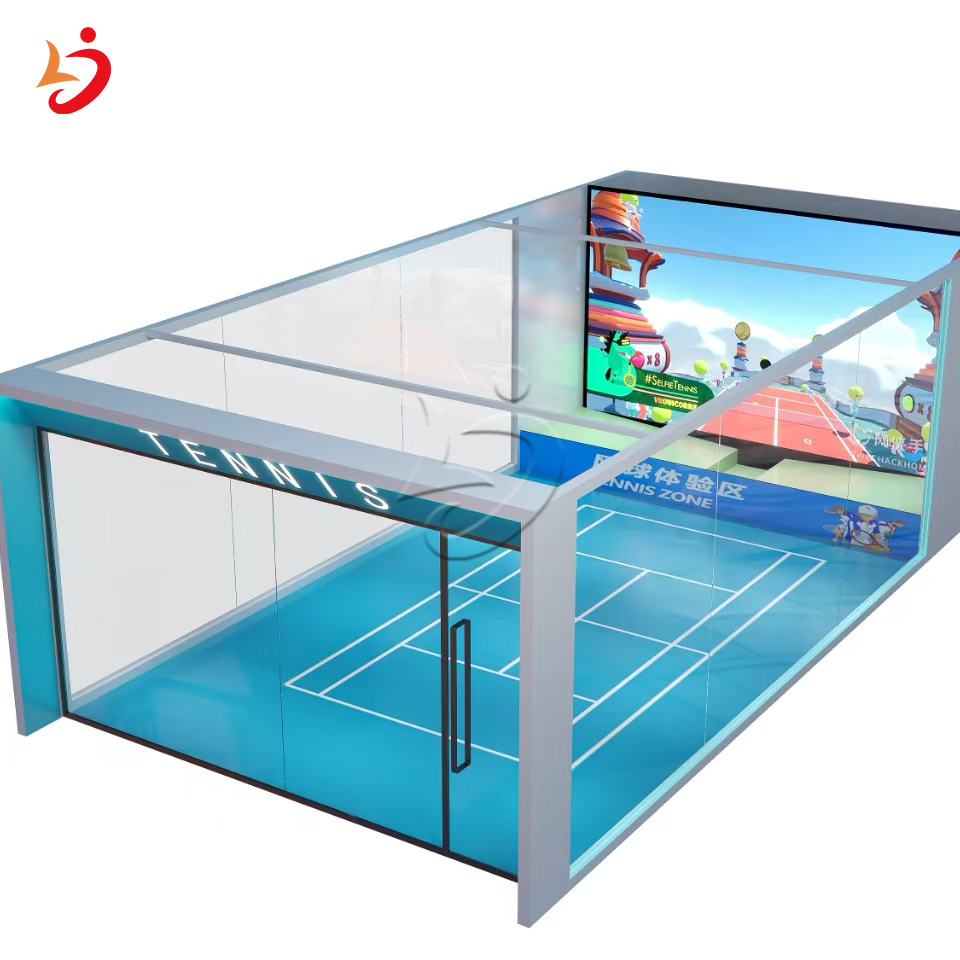
Space strictly dictates your options. You cannot squeeze a full-swing enclosure into a standard spare bedroom. We must look at strict, verifiable architectural requirements. This helps homeowners accurately qualify their space before making decisions.
Industry consensus dictates very strict minimums. You need approximately 16 feet in width. You need 20 feet in length. Most importantly, you need at least 10 feet of ceiling height. Why is ceiling height so exceptionally critical? A full serving motion requires maximum vertical racket extension. You will damage your ceiling or your racket if you ignore this metric. We see this common mistake far too often. Homeowners meticulously measure floor space but completely forget vertical clearance. A 9-foot ceiling practically guarantees a broken racket during a kick serve.
Baseline dimensions allow basic restrictive play. Optimal dimensions allow completely unrestricted movement. For a truly immersive experience, we recommend pushing your space boundaries further. Aim for 16 feet 9 inches in width. Extend the overall length to 36 feet. Raise the ceiling to 10 feet 6 inches. This extra room allows deep baseline rallies. It gives you adequate space to retreat against heavy topspin shots.
What actually goes into this dedicated space? A premium setup requires several distinct large elements. You must accommodate all of them safely.
Enclosure Netting: Heavy-duty side baffling catches stray balls effectively. It protects your surrounding walls.
Impact Screen: A specialized multi-layer projection screen absorbs high-velocity ball impacts safely.
Flooring Surfaces: Customizable options usually include artificial hard court, durable carpet, or synthetic clay.
Kiosk and Projector Housing: Protective casing keeps delicate electronics completely safe from unpredictable ricochets.
Here is a quick comparison table. It helps you visualize your spatial requirements clearly.
Dimension Type | Width | Length | Ceiling Height | Best Used For |
|---|---|---|---|---|
Baseline Minimum | 16 feet | 20 feet | 10 feet | Compact basement training, controlled serving drills. |
Optimal Recommended | 16' 9" | 36 feet | 10' 6" | Full baseline play, unrestricted defensive movement. |
Marketing fluff often clouds the simulator buying process. We must focus strictly on the actual technical specifications. These dictate accurate performance data capture. A visually stunning screen means absolutely nothing if the underlying metrics fail.
Basic setups often rely on simple radar technology. Radar tracks straight-line speed very well. However, it struggles with precise spatial positioning and heavy rotation. High-end systems take a much more sophisticated approach. They use photometric tracking. This involves specialized high-speed cameras combined with infrared lighting arrays. These cameras capture thousands of frames per single second. They analyze the ball's exact deformation and logo rotation. Think of the professional Hawk-Eye technology used in major Grand Slams. The best home systems scale this exact technology down for indoor use.
A reliable Tennis Simulator must capture more than just simple ball speed. It needs to provide a comprehensive picture of your shot mechanics. Look for systems tracking these specific metrics accurately:
Spin Rate: Accurate systems measure heavy topspin and slice backspin up to 5000 RPM.
Launch Angle: This metric directly determines your net clearance and overall shot depth.
Shot Depth: Understanding exactly where your ball lands on the virtual court surface.
Ball Trajectory: The complete 3D flight path of your shot from racket contact to the impact screen.
Hardware merely captures the raw data. Software makes this data useful. You want systems offering detailed instant replay. Technique breakdowns allow you to analyze your entire kinetic chain. Customizable environments add brilliant realism. You can change the virtual weather or the court surface instantly. Engaging target-challenge modes keep younger family members highly interested. Gamification turns repetitive drills into fun competitive games. This significantly improves long-term skill retention for players of all ages.
Building a dedicated home facility requires careful, methodical planning. We must analyze implementation realities transparently. This prevents unpleasant surprises during the construction phase.
Implementation difficulty directly scales with hardware complexity. Mid-range solutions involve sensor-augmented pop-up nets. You can easily assemble these yourself in a single afternoon. Professional-level systems present a completely different challenge. Turnkey commercial-grade enclosures require expert professional installation. They adapt complex commercial technology for residential basements. You cannot simply unpack these heavy boxes and start playing. They require precise spatial calibration.
Hardware alone does not guarantee a permanently functioning system. Most high-end platforms rely heavily on continuous software integration. You need highly stable internet connectivity. Systems require regular live updates. Developers push vital bug fixes and refine ball physics algorithms remotely. Remote tech support ensures maximum system uptime. Multiplayer functionality also depends on robust network performance. You must treat the software as a living, breathing ecosystem.
You must set realistic implementation timelines early. Custom simulator enclosures take considerable time to manufacture. Hardware delivery requires careful heavy-freight logistics. You should typically expect an 8 to 12-week lead time. This timeframe includes custom manufacturing, international shipping, and professional on-site assembly. Use this waiting period wisely. Prepare your room. Reroute HVAC ducts if they hang too low. Ensure your electrical panel easily handles the extra load for bright projectors and motorized ball machines.
We must address core user objections realistically. Tennis purists often remain highly skeptical of indoor digital technology. Addressing these critiques head-on establishes authenticity and trust.
Experienced players frequently raise a very valid critique. They argue a Tennis Simulator cannot perfectly replicate a heavy baseline rally. They are absolutely correct. Hitting against a programmable machine feels different than absorbing the pace of a live opponent. The physical impact screen stops the ball dead upon contact. You do not get the visual follow-through of the ball traveling across a full 78-foot court. The physical sensation differs slightly from outdoor play.
We should correctly frame this technology as an elite supplementary tool. It does not replace live court time. It heavily enhances it. Simulators excel at grooving strict muscle memory. You can hit 500 identical forehands in a single hour. You can drastically improve your serve return reaction times against high-speed feeds. Advanced ball machines can simulate blistering 130 mph serves. You can easily maintain your fast footwork and cardiovascular conditioning during harsh winter months. You achieve massive training volume in minimal time.
Dedicated indoor floor space represents a significant home investment. You should maximize this utility wherever possible. Many top-tier software systems offer brilliant multi-sport capabilities. The exact same hardware frequently doubles as a golf or soccer simulator. This maximizes your home square-footage utility significantly. It turns a single-use training space into a complete family entertainment center.
Buying a Tennis Simulator closely resembles a major home renovation project. It requires highly precise spatial planning. You must understand the complex logistical realities beforehand. You also need very realistic performance expectations. First, grab a standard tape measure. Measure your exact ceiling height carefully. If you lack 10 full feet of vertical clearance, acknowledge your strict limitations. Decide between a purely virtual reaction-trainer or a fully enclosed physical setup based directly on your available space.
Finally, take decisive action. Request full technical spec sheets from top industry vendors. Better yet, schedule a physical demo. Test the tracking system latency and ball machine capabilities yourself before committing to a massive installation. Your game deserves the right technological fit.
A: Ten feet is the strict standard minimum. This height safely accommodates a full serving motion. It allows maximum racket extension without damaging the ceiling or breaking your equipment. However, experts highly recommend 10.5 feet for completely unrestricted play.
A: Yes. Advanced features like instant slow-motion replay prove invaluable. Target-based gamification makes learning highly engaging. It allows beginners and children to learn complex mechanics comfortably without the intense pressure of a live public court.
A: Yes. Premium setups utilize photometric cameras and infrared lighting arrays. They capture thousands of frames per second. This technology accurately tracks extreme topspin and heavy backspin slice, often reading ball rotation rates up to 5,000 RPM.
A: Expect an 8 to 12-week total lead time from your initial order. This extended timeframe accounts for custom enclosure manufacturing, heavy freight shipping, and professional on-site assembly of the screen and delicate AV equipment.
