


Views: 0 Author: Site Editor Publish Time: 2026-05-29 Origin: Site


For facility operators, coaches, and premium home users evaluating a professional Tennis Simulator, the underlying tracking technology is the primary differentiator between an arcade game and a viable training tool. The market is saturated with conflicting claims about "smart tracking." However, translating real-world ball physics into accurate digital outputs requires specific hardware. Understanding the shift from physical wearables to optical vision systems is critical. You must shortlist a simulator delivering credible performance analytics and acceptable ROI. Buyers face confusing specifications daily. They must look past the marketing jargon quickly. True ball physics demands high-grade camera setups. You need tracking systems mirroring tour-level technology. Wearables compromise natural swing mechanics severely. They disrupt stroke timing and physical habits. The industry standard now relies on passive visual data. Readers will learn the exact sensor technologies powering these complex systems. We will explore how cameras calculate aerodynamic physics like the Magnus effect. You will discover actionable criteria for selecting commercial-grade technology.
Professional simulators prioritize optical camera arrays (vision sensors) over physical wearables or embedded ball sensors to maintain realistic gameplay and ball dynamics.
High-end systems utilize machine learning and triangulation algorithms—similar to tour-level Hawk-Eye technology—to track speed, trajectory, and spin (RPM) without altering the racket's weight distribution.
Capturing the Magnus effect (fluid pressure differentials caused by topspin/backspin) is the ultimate test of a simulator's sensor accuracy.
Commercial viability relies on "sensor fusion" that enables continuous play (up to 1,000 balls per hour) in a fraction of a traditional court's footprint.
Buyers face a significant business problem. They must choose a system capturing highly accurate data. It cannot interfere with a player's natural mechanics. Physical sensors often fail this usability test. Let us examine why this happens in real-world environments.
These devices rely on accelerometers, gyroscopes, and magnetometers. They typically attach to the racket butt. Sometimes, manufacturers embed them directly inside the ball.
GPS struggles immensely indoors. Signal bounce creates multipath errors. Pulse-based latency ruins tracking accuracy completely. You cannot achieve sub-millimeter precision using standard satellite signals inside a metal-framed commercial building.
Adding hardware to a racket changes weight distribution. It alters muscle memory completely. Elite players notice even a 10-gram variance. Embedding hardware inside balls presents other problems. It makes meeting International Tennis Federation (ITF) standards difficult. Balls lose authentic weight profiles. Their bounce characteristics change dramatically. Microchips inside a hollow rubber core cannot survive repeated 120-mph impacts.
High-end setups use high-frame-rate camera arrays. They operate at speeds up to 1000fps. Installers position them strategically around the physical enclosure.
This method offers zero interference. Players use their standard rackets freely. They hit regulation yellow, green dot, or orange balls. The system tracks the environment passively. You eliminate the need for constant hardware charging. You remove pairing issues entirely. The cameras act as unblinking umpires.
Chart: Tracking Technology Comparison | ||
Feature | Physical Sensors (Wearables/Smart Balls) | Optical Vision Sensors (Cameras) |
|---|---|---|
Player Interference | High (changes swing weight) | None (passive tracking) |
Indoor Accuracy | Low (signal bounce, lag) | Very High (sub-5mm precision) |
Ball Standards | Often fails ITF weight limits | Uses standard regulation balls |
Maintenance | Constant charging, frequent breakage | Minimal (fixed hardware) |
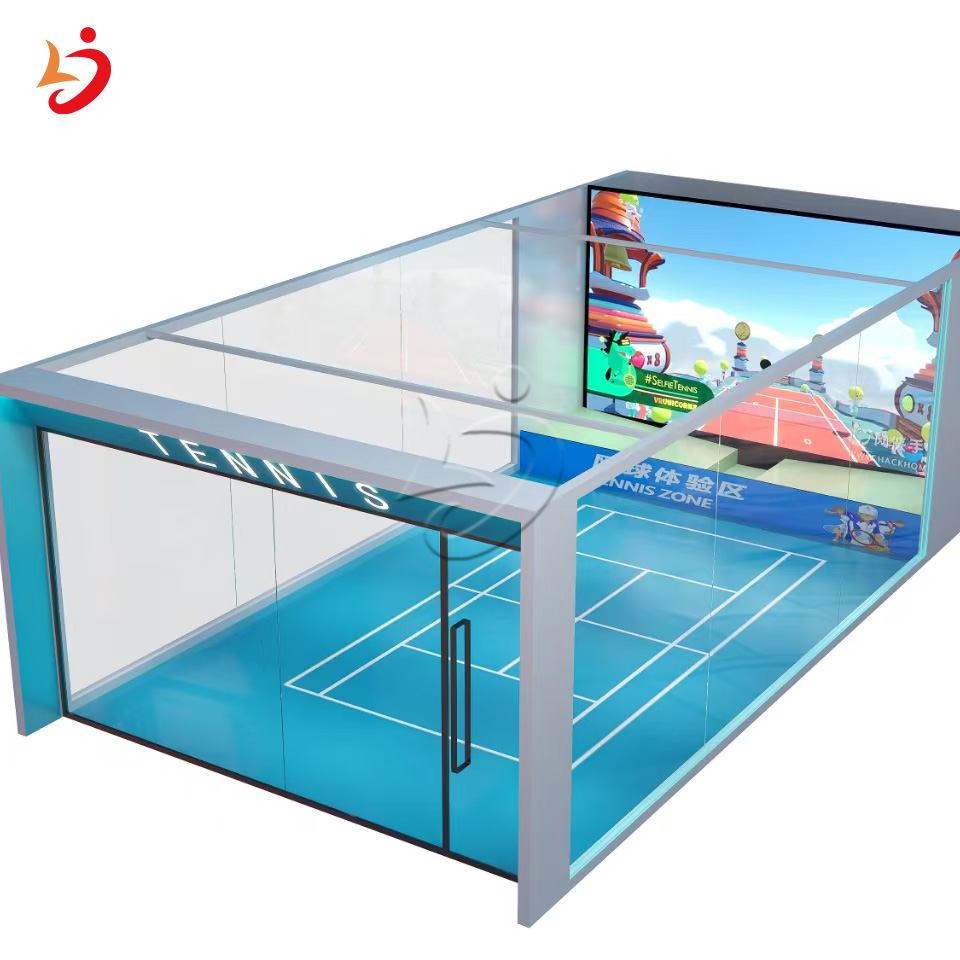
Let us break down the underlying optical mechanics. You need to understand how lenses interpret fast-moving objects indoors.
High-speed cameras capture the ball from multiple angles simultaneously. The software constructs a 3D trajectory model instantly. Triangulation precisely locates the ball in space. If camera A sees the ball against a screen, and camera B sees it from the ceiling, the intersecting geometry determines exact coordinates. The processor updates these coordinates hundreds of times per second.
Advanced systems do more than register screen impacts. They leverage complex machine learning protocols. These algorithms predict the statistical likelihood of a flight path. They analyze initial launch conditions instantly off the stringbed. The system calculates trajectory before the ball even touches the projection screen. You get sub-5-millimeter accuracy through predictive analytics. AI distinguishes between a moving white shoe and a fast-moving ball effortlessly.
Computational photography once belonged exclusively to multimillion-dollar professional tournaments. Engineers have optimized this technology heavily. Now, commercial indoor setups utilize similar methodologies. You get stadium-level precision in a much smaller footprint. Moore's Law made sensor hardware affordable. Cloud computing made the necessary processing power accessible. Small facilities now afford tech once reserved for Grand Slam center courts.
What should commercial buyers look for in technical specifications? You must map software features to actual coaching outcomes.
This remains the hardest metric to capture indoors. Without precise RPM data, systems fail completely. Topspin, backspin, and sidespin alter aerodynamics. The simulator must calculate the Magnus effect accurately. This fluid dynamics principle pushes spinning balls downward or upward. High topspin creates low air pressure below the ball. It forces the object to dip sharply. Poor sensors result in unrealistic ball drops. They produce floating trajectories defying physics. If a simulator cannot read 3000 RPM topspin, it becomes useless for advanced players.
These metrics prove critical for effective serve training. Sensors must instantly capture ball speed off the stringbed. They must calculate the vertical launch angle perfectly. This simulates baseline rallies perfectly. It also enables accurate serve return practice. Velocity defines the pace of the virtual rally. If the sensor lags by a fraction of a second, the virtual opponent's return timing feels entirely artificial.
Top-tier simulators utilize broad-range sensing protocols. They track the ball accurately. They also capture the player's skeletal posture continuously.
Instant Replay: High-definition playback highlights contact points.
Split-Screen Analysis: Coaches compare mechanics against data outputs.
Joint Tracking: Some systems overlay skeletal lines on player footage.
This broad sensing creates a complete feedback loop. You see the mathematical result of the shot. You also see the biomechanical flaw causing the error.
How do you deploy this hardware successfully? Let us examine the spatial and operational rules dictating facility integration.
High-quality sensor setups require calibrated space. Leading systems demand only 1/8th the footprint of a standard court. However, they demand strict adherence to environmental rules. Screen distance matters significantly for camera angles. Optical sensors function optimally only under controlled conditions.
Ceiling heights must clear racket swing paths safely.
Ambient lighting must remain consistent to avoid shutter confusion.
Wall colors should contrast with the ball for better optical isolation.
If you ignore these physical constraints, even the best sensors generate flawed data.
A robust sensor system pairs beautifully with an AI ball-feeding machine. This integration eliminates manual ball retrieval entirely. Training density skyrockets immediately. Traditional courts yield roughly 150 balls per hour. An advanced Tennis Simulator pushes this to 1,000 balls per hour. This throughput represents a critical metric for facility ROI. It directly drives membership sales. Players pay for efficiency. They achieve higher heart rates in shorter sessions.
Understand exactly what you are purchasing. Vendors supply the core sensor arrays. They provide projectors and computing kiosks. Facility owners typically handle the physical enclosure. You must build out impact screens and structural elements. You arrange the flooring and containment netting. Software often requires a monthly subscription. This subscription ensures continuous AI model updates. It keeps the computer vision algorithms sharp. It adds new training scenarios regularly.
You need practical steps for evaluation. Separating premium sensors from novelty gadgets requires strict testing protocols.
Avoid systems requiring proprietary "smart balls". These degrade quickly under heavy impact. They cost significantly more to replace than standard cans. Avoid platforms mandating bulky racket attachments. You want baseline accuracy without physical interference. Also, reject systems relying on single-camera setups. Depth perception requires multiple lenses mapping the 3D space.
Request a live demonstration before committing. Focus specifically on heavy topspin shots. Test varied slice speeds in "rally mode". Ensure the system reads these nuances accurately. Hit a heavy slice approach shot. Watch if the virtual ball stays low after bouncing. If the virtual bounce feels uniform regardless of your applied spin, the sensors lack RPM tracking.
Assess your facility carefully today. Measure ceiling height accurately. Evaluate ambient lighting control options. Shutter performance depends heavily on consistent lighting levels. Define your target demographic clearly. Decide between casual entertainment seekers and professional development players. Each group requires different software modes. Clarify these variables before requesting vendor quotes. Proper preparation prevents costly installation mistakes.
We covered the critical shift from physical attachments to advanced optical tracking. You now understand how commercial systems operate.
Summary: The modern professional tennis simulator relies heavily on optical camera arrays. Machine learning algorithms replace physical hardware attachments. Complex tracking handles both the ball and player kinematics.
Takeaway 1: Always prioritize triangulation-based vision setups to ensure realistic RPM and Magnus effect calculations.
Takeaway 2: Prepare your facility footprint precisely, ensuring lighting and dimensions support high-speed camera functionality.
Takeaway 3: Use metrics like throughput (balls per hour) to calculate commercial viability and member value.
Final Word: By prioritizing passive visual tracking, facility operators offer a frictionless environment. You provide highly accurate training scaling commercially. This approach satisfies the strict demands of competitive players perfectly.
A: No. Premium optical-based simulators allow players to use standard yellow, green dot, or orange balls. The cameras track the object visually, eliminating the need for expensive, sensor-embedded balls. This keeps maintenance low and preserves authentic ball feel.
A: High-end commercial simulators utilize similar multi-camera triangulation methodologies as professional stadium tech. They capture speed and spin with precision margins often within millimeters. AI predicts flight paths instantly, matching real-world physics closely.
A: Advanced models include player-facing cameras syncing with ball-tracking data. This provides split-screen instant replays. It pairs quantitative ball flight data with qualitative stroke mechanics, enabling comprehensive coaching and biomechanical correction.
