


Views: 0 Author: Site Editor Publish Time: 2026-05-27 Origin: Site


Tennis training is evolving rapidly across the globe. We are moving away from purely subjective coach feedback. Standard ball machines are giving way to highly accurate, data-driven digital environments. Many players struggle heavily to translate verbal coaching cues into physical adjustments. It is incredibly frustrating. You cannot easily fix mechanical flaws when you cannot see or measure your own body positioning in real-time. This creates a massive disconnect between what you feel and what actually happens during a swing.
Fortunately, a modern Tennis Simulator provides critical swing analysis. Whether you use a full hardware installation or an AI-driven vision app, this technology quantifies your biomechanics. It accurately tracks ball flight and completely eliminates subjective guesswork. You will learn exactly how these systems decode your swing. We will also cover the exact technical baselines required for accurate tracking and rapid skill improvement.
Tennis simulators bridge the gap between "feel" and "reality" by providing measurable data on racket tilt, swing path, and kinetic energy transfer.
The market offers three distinct approaches: Full-room AR hardware, AI-powered computer vision (CV) apps, and wearable IMU (sensor) technology.
Accurate swing analysis relies heavily on proper implementation, including correct camera angles (e.g., 45-degree front angles), minimum frame rates (60fps), and stable mounts.
Beyond technique correction, these tools drastically reduce review time (via dead-time removal) and aid in injury prevention by identifying joint over-extension.
Traditional tennis coaching builds strong fundamentals. However, it often hits a ceiling when addressing micro-mechanical flaws. Coaches rely heavily on naked-eye observations. This approach introduces unavoidable gaps in athletic development.
The Subjectivity Problem: Traditional lessons frequently rely on generic tips. Coaches might tell you to "bend your knees" or "follow through." These cues lack functional, root-cause analysis. Hitting the net versus hitting long requires different bodily adjustments. Subjective advice cannot pinpoint the exact millisecond your wrist angle failed.
Lack of Data Retention: Standard on-court sessions rarely utilize high-speed video review. You leave the court without a visual baseline. Tracking long-term progress becomes a guessing game. You cannot manage what you do not measure.
Cost-to-Value Ratio: Offline coaching costs remain high worldwide. Players desperately need supplementary tools. Continuous, quantifiable feedback between professional lessons maximizes your training investment. It bridges the gap between weekly coaching sessions.
The Shift to Functionality: Modern sports science focuses less on achieving a "picture-perfect" standard swing. It prioritizes the functional efficiency of your unique kinetic chain. Digital tools measure how well your specific body type generates and transfers power.
Common Mistake: Do not use digital analysis to override your coach. Use it to supplement their advice. Bring your swing data to your next lesson. Your coach can translate those numbers into actionable on-court drills.
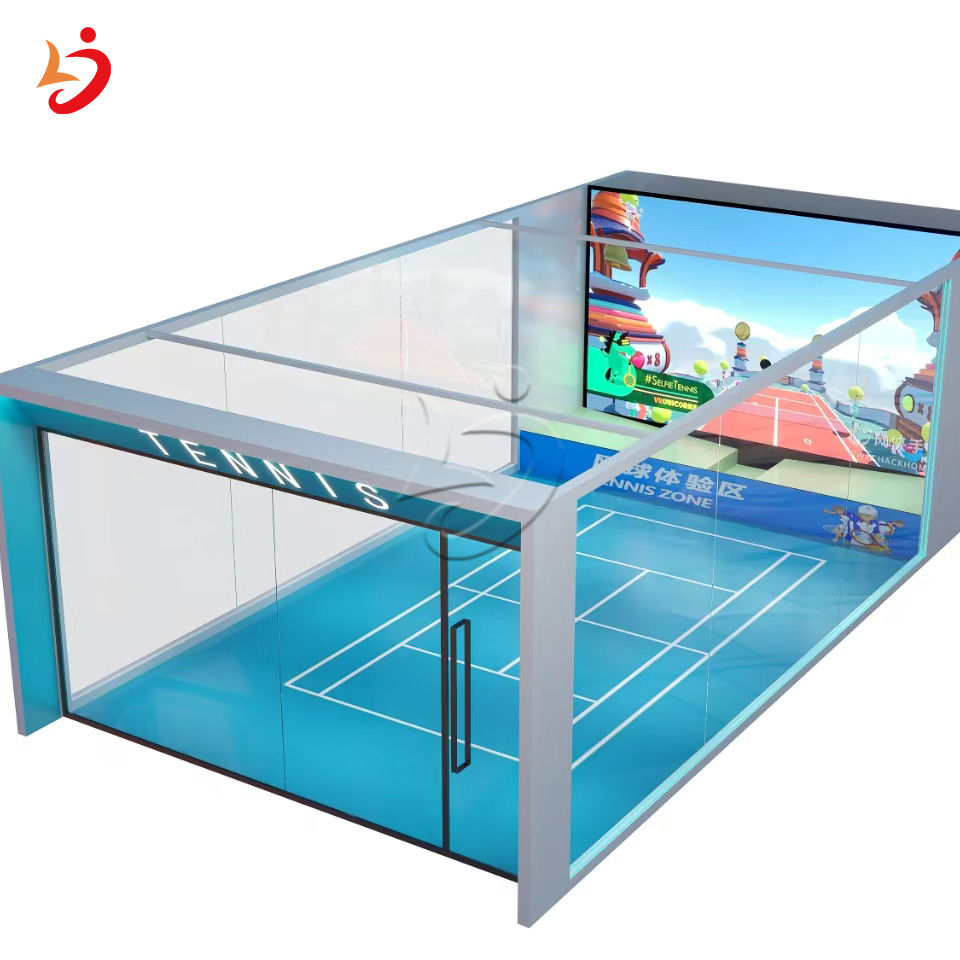
The term "simulator" covers a broad spectrum of technology. Each setup captures swing mechanics differently. Understanding these categories helps you select the right analytical tool.
These represent full-scale commercial setups. They combine advanced ball machines, visual screen projections, and military-grade radar. They track advanced metrics instantly. You get real-time data on spin rates, ball depth, and player footwork. These environments gamify the training experience. You face virtual opponents while radar meticulously maps your shot trajectories. It is the closest alternative to a real indoor court.
This software utilizes standard smartphones. You mount your camera to a fence or tripod. The software uses artificial intelligence to overlay skeletal frames onto your body. These "stickman models" map your joint angles precisely. They track the ball's flight path without physical sensors. CV apps process thousands of pixels per frame. They determine if your shoulders rotated adequately before contact.
These solutions rely on smartwatches or smartphone-in-hand setups. They use internal accelerometers and gyroscopes to capture micro-biomechanical data. They track wrist rotation, arm elevation, and impact acceleration. This data syncs directly to a mobile device. Coaches and players review the numbers instantly. Wearables excel at capturing invisible forces like torque and kinetic timing.
Technology Type | Primary Analysis Method | Best Use Case | Key Advantage |
|---|---|---|---|
Physical AR & Radar | Radar tracking & optical projection | Commercial academies, elite training | High-fidelity ball flight & spin tracking |
Computer Vision (CV) | AI skeletal overlay (Stickman) | Solo practice, club matches | No extra hardware needed beyond a phone |
Wearable Sensors (IMU) | Accelerometers & gyroscopes | Micro-biomechanical review | Precise capture of wrist torque & timing |
A high-quality Tennis Simulator does more than record video. It dissects your movement into quantifiable metrics. These data points reveal the hidden mechanics behind your unforced errors.
Kinetic Chain Visualization: Great tennis strokes start from the ground up. Analytics tools identify how energy transfers from your legs. They track it through your hips, shoulders, and into the racket. The software flags improper timing. If your arm swings before your hips rotate, the system highlights the power leak.
Posture and Joint Alignment: Precision matters during a rally. Simulators offer micro-analysis of your spine angles. They measure elbow positioning and knee bends. They evaluate your posture during both the preparation and follow-through phases. Proper alignment prevents chronic back injuries.
Racket Face & Path Dynamics: Millimeters dictate where the ball lands. Analysis software provides precise measurements of your racket face tilt. It identifies an open versus closed face at the exact moment of impact. It maps the overall trajectory of your swing path, highlighting a low-to-high or overly flat motion.
Impact Detection & Calibration: Finding the sweet spot requires consistency. Algorithmic impact detection identifies your exact contact point. Many systems utilize specific G-force acceleration thresholds (e.g., 3.5G) to log hits. This helps the AI differentiate between stroke types like topspin, flat, or slice.
Best Practice: Focus on one metric at a time. Trying to fix your kinetic chain, racket tilt, and posture simultaneously leads to paralysis by analysis. Master your footwork and energy transfer first.
Even the most advanced software fails under poor conditions. Accurate swing analysis relies heavily on strict setup parameters. You must respect the technical baselines to generate reliable data.
Video-based AI requires strict environmental control. You need stable tripods. Handheld video introduces too much shake for algorithms to process. The preferred recording position is a 45-degree front angle. This specific angle avoids perspective distortion. It allows the camera to see your grip and your body rotation clearly. Sensor apps require specific device orientations. A smartwatch must face a specific direction to establish accurate 3D coordinates.
Tennis swings are explosive. Reliable analysis requires a minimum of 60 frames per second (fps). Standard 30fps video blurs the exact moment of impact. Drops in framerate degrade data quality instantly. Poor lighting also severely hampers computer vision. Always record in well-lit environments to help the AI detect the ball and your limbs.
You must understand metric differences across platforms. AI vision apps often calculate the average speed of the ball. They measure it across its entire flight path. This number reads lower than the initial exit velocity. Professional broadcast radars measure initial velocity right off the strings. Do not panic if your AI app shows a slower serve than a professional radar gun.
Machine learning models require massive datasets. Many early-stage swing algorithms optimize heavily for right-handed players. Left-handed users sometimes experience minor tracking errors. Developers continually update these systems. However, you should verify if your chosen app fully supports left-handed mechanics before relying on its data.
Technology should match your ambition level. Selecting the right setup depends entirely on your specific training objectives.
Recreational players benefit immensely from free or low-tier AI vision apps. These tools automate video clipping effortlessly. They remove dead-ball time automatically. This compresses a scattered two-hour match into 15 minutes of actionable footage. You also get basic shot charting. It is the perfect entry point for players wanting visual feedback without complex hardware.
Tournament players need granular data. Wearable sensor ecosystems or premium AI subscriptions fit this demographic perfectly. These platforms track long-term Key Performance Indicators (KPIs). You can monitor first serve percentages and break point conversions over an entire season. They also allow real-time multi-device syncing. A coach can view biomechanical data on an iPad while the player remains on the baseline.
Tennis clubs require robust solutions to attract clientele. High-end AR tennis simulators offer incredible value here. They provide engaging gamification for younger players. They serve as extreme weather alternatives when outdoor courts close. The high-fidelity radar tracking supports elite training regimens. It transforms a standard facility into a premium, data-driven academy.
A tennis simulator stands as a highly effective tool for comprehensive swing analysis. It successfully transforms invisible kinetic flaws into actionable visual data. You no longer have to guess why a forehand sailed long. The numbers reveal the exact breakdown in your posture or racket face angle.
Determine your primary use case before upgrading your gear. Decide if you need solo video review or live biomechanical tracking. Ensure your baseline recording equipment meets the necessary 60fps requirement. Invest in a sturdy tripod or fence mount first. Embrace this digital shift, apply the insights functionally, and watch your on-court consistency dramatically improve.
A: Yes. By utilizing skeletal overlay technology, modern software maps your bodily movements frame by frame. It can easily identify joint over-extension, improper spine angles, and imbalanced kinetic loading. Catching these mechanical flaws early frequently prevents severe muscle strains and chronic joint pain.
A: Under ideal conditions, top-tier AI apps perform exceptionally well. You need 60fps recording and proper mounting. When set up correctly, they can achieve up to 97% accuracy on line calls within 10 centimeters. Speed tracking error margins are generally kept strictly under 10%.
A: Not necessarily. While commercial AR simulators require heavy physical installations and radar, everyday players have easier options. Most players can achieve deep swing analysis using just a modern smartphone. You only need a sturdy tripod or fence mount alongside a dedicated AI coaching application.
