


Views: 0 Author: Site Editor Publish Time: 2026-10-14 Origin: Site


Hitting a powerful smash that sails out of bounds or drives straight into the net is a universal frustration. Raw power without precise placement hands free points directly to your opponent. Fixing these micro-errors traditionally required endless multi-shuttle drills and highly subjective coaching feedback. Today, hardware engineering offers a far more precise alternative. By integrating a Badminton Simulator into your training facility, you can systematically address accuracy issues through real-time biomechanical analysis. This data-driven approach delivers targeted repetition that traditional on-court practice simply cannot match.
Data-Driven Adjustments: Modern simulation technology provides instant metrics on shuttle speed, launch angle, and landing coordinates.
Target Pattern Training: Digital environments allow players to repeatedly hit specific placement zones, locking in essential muscle memory.
Advanced Optical Tracking: High-speed sensors calculate the exact contact point and racket face angle to correct flawed timing.
Efficient Repetition: Automated systems offer limitless, perfectly consistent feeds without the fatigue associated with human partners.
Objective Analysis: Concrete digital data bridges the critical gap between raw physical power and match-winning precision.
Looking at the broader trajectory of sports technology, there is a definitive industry-wide shift toward quantitative training methodologies. Elite coaching is rapidly moving away from purely intuition-based feedback. High-speed analytics is now the gold standard. As optical tracking algorithms mature, amateur athletes and commercial venues now have access to the same biomechanical insights once reserved for Olympic-level centers. This evolution highlights why digital simulation is no longer just a luxury entertainment feature. It is a fundamental component of modern skill acquisition. From a strict sports science perspective, simulators provide the exact controlled conditions necessary for rapid motor learning.
The smash remains the most complex and physically demanding shot in the sport. It requires a flawless kinetic chain. Energy must transfer seamlessly from the legs, through the rotating core and shoulder, and finally down into the wrist and racket head. Maintaining pinpoint accuracy while balancing these physical variables under pressure is incredibly difficult.
Timing serves as the foundational element of a precise strike. Hitting the birdie relies heavily on intercepting it at the absolute optimal spatial coordinate. Imagine leaping for a jump smash with your racket primed, but striking the bird a fraction of a second too early. The resulting trajectory is typically flat and sails past the baseline. Conversely, letting the shuttle drop too low forces a compromised downward racket angle, driving the shot directly into the net. Maintaining a consistently high contact point slightly in front of the body is non-negotiable for steep accuracy.
Furthermore, players frequently sacrifice accuracy when attempting to generate maximum racket head speed. When you over-swing with maximum effort, core stability wavers. Fine wrist control naturally degrades. Professional athletes counter this by utilizing controlled aggression. Swinging at roughly 80 percent of maximum capacity ensures the shuttlecock lands precisely on the court lines. Statistically, a well-placed 80 percent smash is far more lethal than a wild, full-power strike.
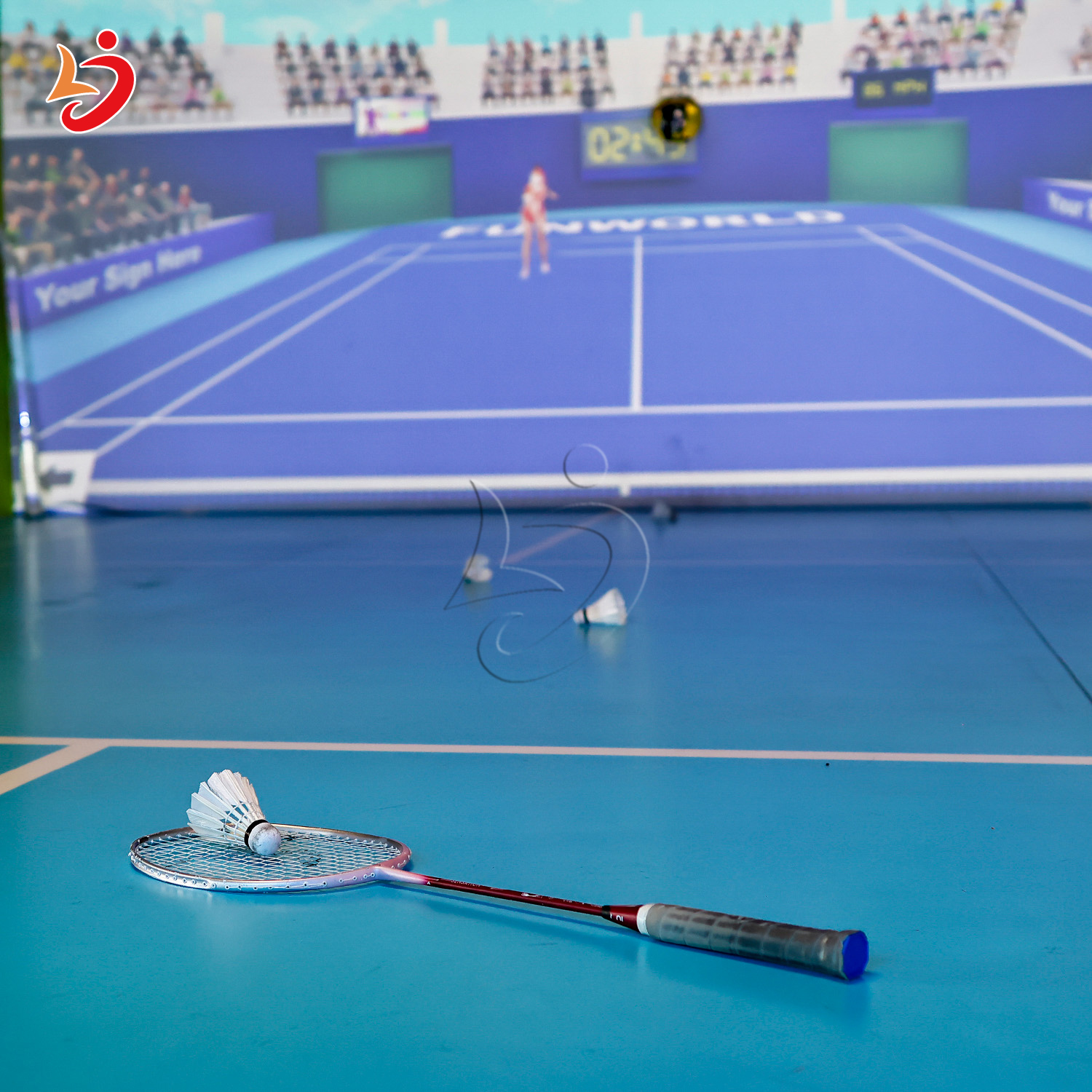
A modern training simulator is a sophisticated integration of physical hardware and analytical software. It replicates authentic on-court play within a controlled indoor environment. Players hit real synthetic or feathered shuttlecocks into an impact-absorbent screen. Instantly, digital sensors render the shot's exact trajectory in a virtual, high-definition court setting.
The effectiveness of these premium systems relies entirely on hardware capabilities. We are talking about sophisticated optical sensors and binocular high-speed cameras operating at over 2000 frames per second. As the racket strikes the shuttle, the Shuttlecock Tracking algorithms calculate the launch angle, initial velocity, and flight path in under 10 milliseconds. These cameras capture the exact moment of impact. They provide granular data that the human eye simply cannot perceive during live play.
Motor learning relies heavily on immediate, actionable feedback. In a traditional setting, a player hits a smash and must visually track it across a 13-meter court. You often lose sight of the exact landing margin. With a simulator, seeing the precise landing spot on a virtual screen immediately after a strike helps the brain rapidly adjust its motor patterns. This closed feedback loop allows the central nervous system to instantly correlate the physical sensation of the swing with the objective outcome of the shot.
Sports scientists highly recommend target-based practice for enhancing spatial awareness. Simulators project highlighted digital targets directly onto the screen. Instead of staring at a massive empty court, you become hyper-focused on a glowing half-meter digital square. Aiming at these specific zones drastically improves cognitive focus during Smash Training, accelerating the development of precise muscle memory.
To fully grasp the value proposition of modern technology, we must compare it directly with traditional multi-shuttle feeding. While manual drills have their place, technology offers undeniable advantages for precision biomechanical work.
Metric | Traditional Coaching | Simulator Training |
|---|---|---|
Feedback Speed | Delayed verbal correction | Instant visual & numerical data |
Data Objectivity | Subjective ("You hit that late") | Precise ("Contact point 5cm low") |
Feed Consistency | Varies as the feeder fatigues | 100% identical mechanical feeds |
Training Independence | Requires a skilled partner or coach | Solo operation available 24/7 |
A coach's subjective eye is invaluable for tactical advice. However, it has distinct limits in biomechanical analysis. Human coaches cannot always see micro-errors in real-time at speeds exceeding 300 km/h. Simulators display the exact racket face angle at the millisecond of impact. Identifying these micro-errors allows players to fix the root cause of wide or netted shots rather than blindly adjusting their overall mechanics.
Simply hitting the shuttle as hard as possible into a screen will not yield the best results. To truly boost your accuracy and ensure it translates to the real court, you need a structured approach.
Start with target zones instead of power. Consciously advise yourself to swing at only 60 percent power. Focus entirely on hitting the virtual targets. Once your accuracy percentage hits a consistent threshold, gradually increase your swing speed by 10 percent increments. Only progress to maximum power when your biomechanics remain completely stable under pressure.
Specifically, analyze your contact point data. Hit 20 smashes and review the system analytics. Find out which contact heights resulted in the steepest, most accurate trajectories. Once you identify that specific vertical measurement, focus your footwork and jump timing on intercepting the shuttle at that exact height on every subsequent repetition. Alternate targets randomly between the left and right sidelines to mimic the complex decision-making required during a live match.
Not all simulation setups are created equal. Investing in simulation technology requires careful evaluation of hardware specifications. For serious facilities looking to improve genuine on-court performance, specific technological benchmarks are absolutely essential.
First, evaluate the camera setup. Because a professional smash is one of the fastest actions in racket sports, low-latency tracking is non-negotiable. Look for binocular vision systems with high frame rates. If the camera frame rate is too low, the software will guess the trajectory rather than measure it. This leads to false feedback. High-fidelity tracking ensures every millimeter of the shuttle's initial flight is captured accurately.
Next, assess the software ecosystem. The hardware is only as good as the algorithms interpreting the data. You need an intuitive user interface that allows players to easily switch between custom drills and view historical analytics. The screen durability must also withstand continuous 300 km/h impacts without warping. This is where a premium Badminton Training Simulator separates itself from basic entertainment setups.
The accessibility of this technology has broadened its appeal dramatically. For athletes competing at regional levels, improvement is all about marginal gains. Professionals rely on data analytics to refine a trajectory by mere inches. This minor adjustment is often the difference between winning and losing a tight championship rally.
Beyond serious training, installing an Indoor Sports Simulator offers a massive return on investment for commercial venues. Casual players and fitness enthusiasts constantly seek gamified experiences. A simulated environment provides an engaging way for recreational players to enjoy the sport without needing advanced skills or a full-sized court. For teaching professionals, it serves as a premium teaching tool that provides documented, visual proof of a student's improvement over time.
Precision is what truly wins badminton rallies. A high-end simulator is a highly effective, data-driven training tool that bridges the gap between raw power and elite accuracy. By providing objective feedback and allowing for limitless targeted repetition, this technology helps athletes master their mechanics. Upgrade your sports facility or personal training routine today by exploring the advanced hardware and software solutions available at LJ Sports Tech.
High-end simulators use advanced optical sensors and high-speed cameras that boast over 95 percent accuracy. They are specifically engineered to capture the high velocities and steep angles of a professional badminton smash without noticeable latency. This ensures the digital flight path perfectly matches the physical strike.
No, but it serves as the ultimate complementary tool. A human coach provides vital strategic advice, tactical awareness, and emotional support. Meanwhile, a simulator delivers objective, real-time biomechanical data and allows for endless, fatigue-free repetition that a human simply cannot provide.
Spatial requirements vary by hardware brand, but you generally need ample ceiling height to allow for a full, unhindered racket swing. Sufficient depth is also required to simulate a realistic court distance from the impact screen safely, allowing players to move and jump naturally.
Yes, the experience is highly realistic. Modern impact screens are specifically designed to absorb the force of the shuttlecock safely while providing an authentic acoustic response. The immediate digital rendering of the flight path creates a highly immersive training environment.
Not at all. While they excel at smash training due to their high-speed tracking capabilities, premium simulators accurately track clears, drops, drives, and delicate net shots. This versatility makes them comprehensive tools for all-around game improvement.
Pricing varies significantly based on the sensor technology, camera frame rates, and software features. Basic setups for casual entertainment are more affordable, while professional-grade systems with binocular high-speed tracking and robust analytics represent a higher capital investment. However, commercial venues often see a rapid return on investment through hourly rentals and premium coaching packages.
Yes. Many national teams and elite badminton academies integrate simulation technology into their training regimens. Professionals use the granular data to analyze micro-adjustments in their racket face angle and contact point height, allowing them to fine-tune their accuracy without the physical wear and tear of full-court sparring.
