


Views: 0 Author: Site Editor Publish Time: 2026-08-14 Origin: Site


The line between a high-ROI commercial installation and a novelty arcade game is dictated entirely by data accuracy and tracking reliability. Latency, misreads, and inaccurate spin rates degrade user trust rapidly. This renders an indoor setup useless for serious training and deeply frustrating for premium entertainment customers. Players expect immediate, realistic feedback that perfectly mirrors their physical actions. When the screen shows a slice but the player felt a draw, confidence in the technology vanishes instantly.
Evaluating the hardware mechanics is essential for facility operators and coaches. Specifically, understanding radar, photometric, and hybrid systems reveals what drives performance. Environmental factors also heavily dictate tracking precision in modern interactive setups. You must match the right sensor technology to your physical space and primary use cases to ensure consistent, verifiable ball flight data. We will examine the exact hardware configurations and environmental controls required to maintain flawless tracking.
Hybrid Superiority: Systems combining Doppler radar and high-speed photometric cameras currently provide the most verifiable, comprehensive data for multi-sport environments.
The Swing-to-Ball Connection: True tracking accuracy requires simultaneous measurement of both the implement (club, bat, or foot) and the ball's launch metrics.
Environmental Dependency: Tracking accuracy is not just a hardware spec; it is highly dependent on environmental control, including lighting flicker, spatial dimensions, and background interference.
Measured vs. Calculated Data: Software calibration and algorithmic physics models dictate how well an indoor sports simulator translates raw sensor data into realistic, low-latency visual feedback.
Use-Case Alignment: Selecting a digital sports simulator requires matching the specific tracking technology to the primary sport's physical demands (e.g., high-spin golf vs. high-velocity baseball).
You cannot manage what you do not measure. A high-quality indoor sports simulator must capture specific critical metrics to function effectively. Missing any of these data points forces the system to guess, leading to inaccurate virtual ball flights. We look for five non-negotiable data points during any installation.
Ball Speed: The exact velocity of the object immediately after impact.
Launch Angle: The vertical trajectory measured in degrees relative to the ground.
Launch Direction: The horizontal azimuth angle indicating left or right deviation.
Spin Rate: Total revolutions per minute applied to the ball.
Spin Axis: The tilt of the spin, which dictates curvature and shot shape.
Latency is another strict success metric. In a commercial setting, the threshold for acceptable latency is typically under 200 milliseconds. This is the time from physical impact to visual on-screen feedback. Anything slower breaks the illusion of reality. Furthermore, you must differentiate between measured data and calculated data. Measured data is captured directly by physical sensors. Calculated data is extrapolated by software algorithms based on averages. Premium systems prioritize measured data for critical flight metrics.
High-fidelity tracking must capture implement metrics alongside ball data. Swing speed, path, face angle, attack angle, and impact location tell the story of the strike. The implement provides the cause. The ball provides the effect. Tracking both ensures the system does not misinterpret a strange bounce or a mis-hit.
Analyzing the physical swing path validates the resulting ball flight trajectory. When a player sees their exact bat angle or clubface orientation on screen, it builds immediate user trust. They understand exactly why the ball behaved the way it did. This dual-tracking approach is mandatory for coaching and serious skill development. If a system only tracks the ball, coaches cannot diagnose the root cause of a mechanical flaw.
Advanced software uses exact launch conditions to mathematically model realistic flight paths. These physics engines calculate lift, drag, and spin decay in real-time. They do this without needing to physically track the ball across its entire outdoor trajectory, which is impossible indoors. The math must be flawless to replicate outdoor conditions.
The physics engine takes the raw data from the sensors at the moment of impact. It then applies environmental variables like virtual wind, altitude, and humidity. This creates a seamless transition from the physical strike into the digital world. The ball lands exactly where it would on a real field or course. Poor physics engines will show a ball floating unnaturally or dropping too quickly, regardless of how good the camera hardware is.
Photometric systems utilize high-speed stereoscopic cameras. These cameras capture thousands of frames per second right at the point of impact. By taking rapid, sequential images, the software analyzes the exact movement of the ball and the implement. We typically install these units either overhead or directly on the floor facing the hitting zone.
These systems are exceptional at measuring precise spin axis, impact location, club path, and launch angle. They excel in highly confined spaces where ball flight is limited. However, they are highly dependent on controlled, consistent lighting. They also struggle with tracking the ball deep into its physical flight path, relying heavily on the initial impact data to generate the rest of the flight.
Doppler radar uses microwave signals to track actual continuous movement. It measures the deceleration, curvature, and landing angles of the ball through physical space. The radar emits a signal that bounces off the moving object and returns to the sensor. This provides a continuous data stream rather than a snapshot.
Radar is superior for tracking high-velocity objects over a distance. It is completely unaffected by ambient lighting conditions. The main limitation is spatial. Radar requires significant indoor space to capture enough ball flight for accurate spin calculations. You generally need at least ten feet of flight from the hitting area to the impact screen, plus another eight feet behind the player for the radar unit itself.
Infrared systems use light curtains to measure velocity and trajectory. As the ball passes through the infrared beams, it breaks the light curtain. The system uses the timing of these shadow interruptions to calculate speed and basic direction. These are often embedded in the floor or the side panels of the enclosure.
These are cost-effective, durable solutions for basic entertainment-focused setups. However, they come with trade-offs. They offer lower fidelity on complex metrics like spin decay and off-axis rotation compared to camera or radar systems. They are best suited for casual arcade environments rather than professional training facilities.
Hybrid tracking merges photometric impact data with radar flight tracking. This methodology eliminates the blind spots of individual systems. Cameras capture the exact moment of impact and spin axis. Radar tracks the initial flight and velocity. This dual-layer approach provides a fail-safe if one sensor misses a data point.
By syncing swing-path tracking with ball launch data, hybrid models set the standard for premium installations. An advanced interactive sports system using hybrid technology delivers unparalleled accuracy. It provides the most comprehensive data set available for serious athletes and commercial venues. The installation is more complex, but the data integrity is unmatched.
Technology Type | Primary Strengths | Main Limitations | Best Use Case |
|---|---|---|---|
Photometric (Camera) | Precise spin axis, impact location, works in tight spaces | Requires strict lighting control, limited flight tracking | Space-constrained indoor training |
Doppler Radar | Tracks continuous flight, ignores lighting issues | Requires large indoor depth (15+ feet) | Large indoor facilities, high-velocity sports |
Infrared/Optical | Cost-effective, highly durable | Low fidelity on spin and off-axis metrics | Casual entertainment venues |
Hybrid (Camera + Radar) | Comprehensive data, eliminates blind spots | Complex installation, higher initial investment | Premium coaching academies, high-end commercial |
Different sports require entirely different tracking capabilities. Golf requires hyper-accurate spin axis and clubhead data. The system must accurately simulate complex shot shapes like draws and fades, as well as ground rollout. A single degree of error in spin axis calculations will result in a massive deviation downrange.
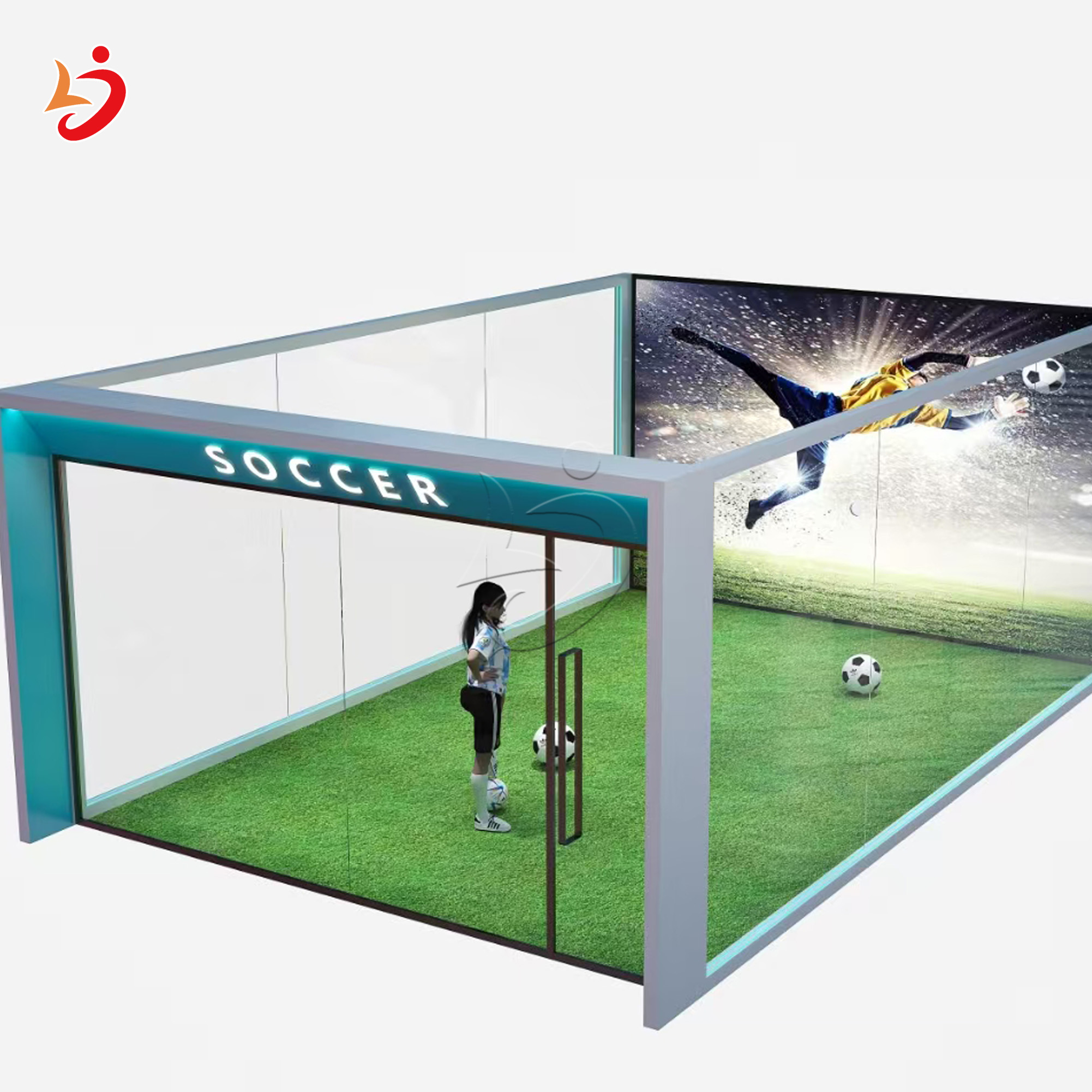
Baseball and softball demand high-speed velocity tracking. Pitch trajectory mapping and immediate impact registration are crucial for batting practice. Soccer and football require the ability to track larger, deformable objects. These sports feature highly variable launch points across a much wider physical area. A soccer ball kicked from the ground behaves differently than a baseball hit at waist height.
You must match sensor types to target audience expectations. A casual entertainment venue prioritizes durability and fast reset times over perfect spin decay algorithms. Infrared or basic photometric setups work well here. The average user in these environments will not notice a slight miscalculation in spin rate.
Conversely, professional coaching academies require a premium multi sport simulator. These environments demand hybrid or high-end photometric systems. The hardware must map directly to the outcome the user is paying for. Granular mechanical improvement requires flawless data capture. Do not install an infrared system if your clients are professional athletes.
Physical space dictates hardware selection. Radar requires depth, often needing 15 or more feet of unobstructed flight to read spin accurately. Camera systems have mounting constraints. Some require overhead installation, while others sit on the floor directly next to the hitting zone. We always measure the room before recommending a specific technology.
Screen distance, ceiling height, and player positioning heavily impact tracking fidelity. If a player stands too close to the screen, radar cannot track enough flight. If the ceiling is too low, overhead cameras cannot capture the full swing path. Planning the physical footprint is a mandatory first step. A standard commercial bay should be at least 15 feet wide, 20 feet deep, and 10 feet high to accommodate most premium tracking systems.
Managing lumen output is critical for photometric systems. You must avoid LED flicker rates that disrupt high-speed camera shutters. Incorrect lighting causes missed frames, resulting in dropped shots or wildly inaccurate data. We recommend using continuous, non-flickering LED fixtures specifically rated for high-speed photography.
Radar-based setups face different challenges. You must eliminate moving background objects like HVAC fans or reflective surfaces. These create false-positives, confusing the radar into tracking a fan blade instead of a golf ball. Environmental control is just as important as the hardware itself in a sports simulator. We often have to relocate ductwork or cover exposed metal pipes during installation to ensure the radar functions correctly.
Routine physical and software calibration is an operational necessity. Sensors drift over time due to vibrations, temperature changes, and general use. Regular calibration prevents this drift and maintains baseline accuracy. We train facility staff to perform basic calibration checks weekly.
You must calibrate camera lenses and align radar units perfectly to the target line. Failure to do so introduces artificial shot shape biases, making straight shots appear as slices. Firmware updates and machine learning improvements also play a massive role in refining tracking algorithms post-installation. Always keep the system connected to the internet to receive these critical updates.
Always independently test a system's accuracy during the procurement phase. Bring industry-standard launch monitors to the vendor demonstration. Compare the data side-by-side to verify their claims. Do not rely solely on the vendor's marketing materials.
Learn to identify misleading specifications. Spot when a vendor relies heavily on simulated algorithms rather than raw sensor measurement. If a system claims to track spin but only uses infrared light curtains, it is calculating that data, not measuring it. Demand transparency on what is measured versus what is guessed by the software. Ask for raw data exports to verify the sensor's actual capabilities.
Audit your available facility dimensions to determine if radar or photometric technology fits your physical footprint.
Define the primary sports and user expectations to avoid over-investing or under-investing in sensor fidelity.
Request raw data export samples from shortlisted vendors to verify their accuracy claims against known baselines.
Establish a strict routine maintenance and calibration schedule to prevent sensor drift over time.
A: Accuracy depends entirely on the technology. High-end photometric and hybrid systems measure spin directly with extreme precision. Lower-tier infrared systems often calculate or estimate spin based on speed and launch angle, which is significantly less accurate.
A: Most use a unified hardware setup, but the software algorithms change. A system might use overhead cameras to track a golf ball's spin, then use the same cameras to track a soccer ball's velocity and trajectory, applying different physics models for each.
A: This delay, or latency, is the time required for sensors to capture data, the software to process the physics calculations, and the projector to render the image. Premium systems keep this under 200 milliseconds to maintain realism.
A: Yes, particularly for photometric systems. Flickering LEDs, uneven shadows, or intense direct sunlight can confuse high-speed cameras, leading to missed frames and inaccurate data. Radar systems are generally immune to lighting issues.
A: Measured data is captured directly by physical sensors, such as a camera seeing the exact spin axis. Calculated data is an estimation made by software algorithms based on other known metrics, which is less reliable for serious training.
A: Radar systems typically require significant depth. You generally need at least 15 to 20 feet of total space from the sensor to the screen to allow the radar to track enough continuous ball flight for accurate measurements.
A: Advanced systems use multiple sensors or high-speed stereoscopic cameras. They capture a wide field of view at thousands of frames per second, allowing the software to isolate and analyze both the implement's path and the ball's resulting launch metrics instantly.
