


Views: 0 Author: Site Editor Publish Time: 2026-08-27 Origin: Site


When a tennis ball travels over 100 mph, subpar tracking hardware ruins the training experience. Players rely on instant, accurate visual confirmation of their shot mechanics. If the virtual ball flight lags or misrepresents the physical strike, the environment collapses. Facilities and serious players investing in an indoor tennis simulator often find that latency, misreads, and inaccurate spin rates degrade user trust. Delayed feedback renders practice sessions ineffective. Instead of focusing on mechanical improvement, players shift their technique to compensate for machine lag, developing bad habits that translate poorly to a real court.
To evaluate a system, buyers must look past marketing claims. You need to understand the technical relationship between camera shutter speeds, processing latency, and stroke data fidelity. This guide breaks down how tracking speed dictates feedback quality and provides the technical knowledge required to assess hardware capabilities before committing to an installation.
Capture Rate vs. Processing Speed: High frames-per-second (FPS) hardware is useless if the software processing introduces display latency; true tracking speed requires optimization of both.
Spin and Trajectory Fidelity: Accurate spin detection relies on high-speed optical capture to read ball seam rotation; systems with slow tracking speeds rely on algorithmic guessing, leading to inaccurate bounce physics.
Player Trust is Fragile: Even a 100-millisecond delay between the physical strike and the virtual ball flight creates a disconnect that ruins the timing and footwork of competitive players.
Dynamic Drill Enablement: Fast, accurate tracking is mandatory for running randomized ball feeds that train a player's visual ball recognition and movement intensity.
Environmental Dependencies: The fastest tracking hardware will still fail without highly controlled indoor lighting and proper camera positioning to eliminate motion blur.
Understanding how a tennis simulator translates physical movement into digital data requires defining tracking speed across three distinct technical pillars. Camera frame rate dictates how many individual images the sensor captures per second. Shutter speed determines exactly how long the camera sensor is exposed to light for each of those frames. Finally, algorithmic processing time measures how quickly the internal computer components translate those raw images into virtual physics on the projection screen. If any of these three pillars bottleneck, the entire simulation suffers.
The mathematical reality of tracking a high-velocity projectile exposes the limitations of consumer-grade hardware. A professional tennis serve traveling at 120 mph covers roughly 176 feet every single second. If a tracking system operates at a standard 60 frames per second, the tennis ball travels nearly three feet between each captured image. This creates massive blind spots in the data. Furthermore, if the camera utilizes a slow shutter speed to compensate for poor room lighting, the resulting image of the ball will be a stretched, blurred streak rather than a crisp sphere. When motion blur occurs, the system cannot identify the ball's exact spatial coordinates or its rotational axis, forcing the software to estimate the shot parameters.
To combat these high-speed capture challenges, progressive scan video modes and global shutter sensors are mandatory. Older or cheaper camera sensors often use interlaced video, which splits each frame into alternating horizontal lines captured fractions of a second apart. When tracking a fast-moving tennis racket or ball, interlaced scanning produces jagged, torn visual artifacts because the object moves significantly between the capture of the odd and even lines. Similarly, rolling shutter sensors capture the image line by line, causing a fast-moving round ball to look like an elongated oval. Global shutter technology exposes the entire sensor simultaneously. This eliminates visual tearing and the "jello effect," providing the clean, actionable data required for precise stroke analysis.
The sequence of data capture in a high-end system follows a strict, millisecond-level protocol:
Impact Detection: Acoustic sensors or initial optical triggers identify the exact moment the racket strikes the ball.
Image Acquisition: High-speed cameras capture a rapid burst of frames (often 120 to 240 FPS) tracking the ball's initial flight path and rotation.
Data Processing: The local PC analyzes the frame-by-frame pixel shift to calculate velocity, launch angle, and spin axis.
Physics Rendering: The software engine applies aerodynamic models, including the Magnus effect, to project the ball's trajectory onto the screen.
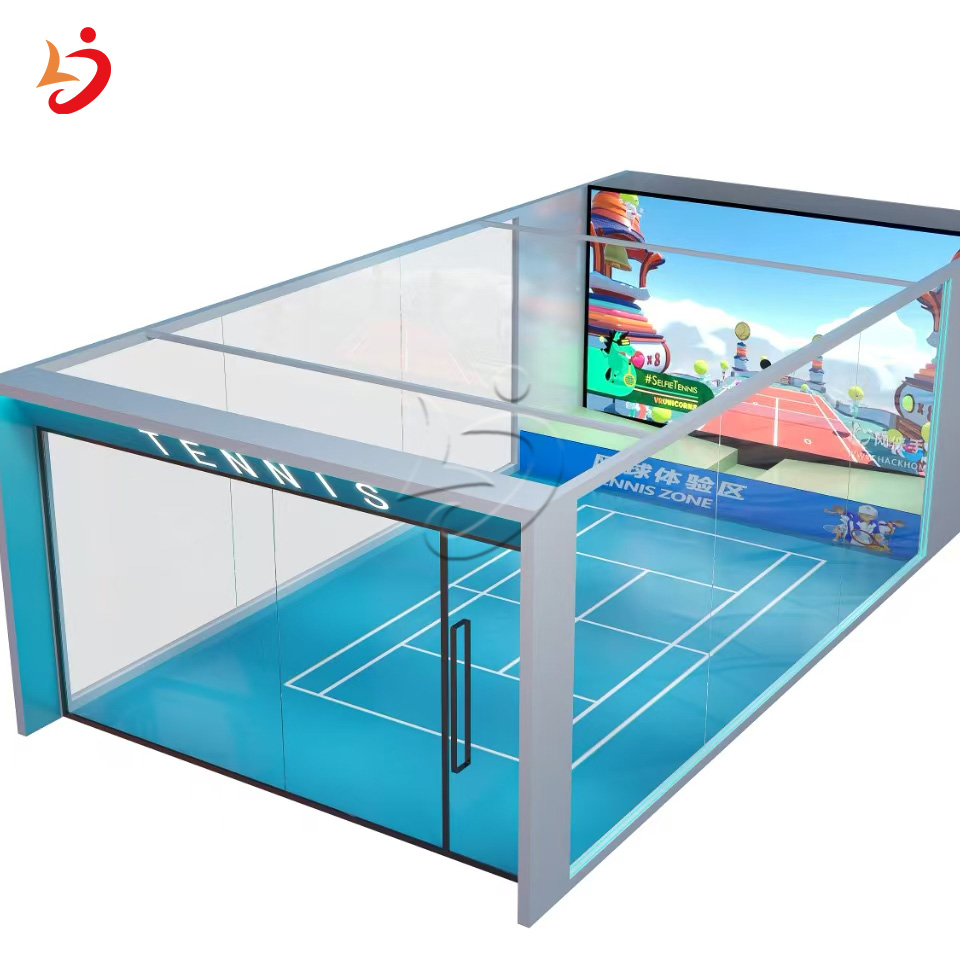
The difference between a flat drive and a heavy topspin shot comes down to the exact rotation of the ball. High-speed tracking technology captures the rapid rotation of the ball's fuzz and seams as it leaves the racket bed. By analyzing how these surface markers shift from frame to frame, a high-end tennis ball tracking system calculates the exact spin rate and axis. This data feeds into the physics engine to replicate the Magnus effect, ensuring the virtual ball dips aggressively and kicks high off the digital court.
When tracking speeds are too slow to freeze the ball's rotation, negative training outcomes multiply. If the camera captures a blurry yellow streak, the system misses the spin data entirely. To keep the simulation running, the software defaults to a flat, generic trajectory. A player executing a perfect, heavy slice will see their virtual shot float straight and long. This false feedback destroys the training value, as the player cannot trust the results of their mechanical execution. They will start altering a fundamentally sound swing just to make the machine register a successful shot.
Advanced tracking hardware extends beyond the ball, monitoring the racket's path through the entire strike zone. Continuous, high-speed capture measures racket head speed, face angle at impact, and the precise swing path. This biomechanical feedback detects physical exhaustion. Late in a rigorous practice set, a player might not consciously feel their swing slowing down. However, the tracking system will detect subtle, five-mile-per-hour drops in racket head speed. Identifying this muscle fatigue and mechanical breakdown early allows coaches to intervene before the player ingrains poor habits born from exhaustion.
Instantaneous, accurate data shifts practice from mindless repetition to targeted mechanical correction. When a player hits into a standard blank net, they rely entirely on feel to judge the shot's quality. High-speed tracking provides immediate, objective truth. Players can adjust their grip, stance, or follow-through mid-session based on exactly where their shots travel and land in the virtual environment. This closed-loop feedback accelerates skill acquisition significantly.
Furthermore, fast tracking speeds enable an interactive tennis simulator to run dynamic court positioning drills and randomized ball feeds. Unpredictable, fast-paced scenarios force players to react instantly, moving laterally and vertically to address incoming virtual shots. These drills teach players that continuous movement and split-step readiness are non-negotiable. By demanding high footwork intensity, the system directly improves a player's visual ball recognition and mimics the chaotic, high-pressure environment of actual match play.
Shot Execution | High-Speed Optical Result | Low-Speed Algorithmic Result |
|---|---|---|
Heavy Topspin Lob | Accurate high arc with aggressive downward dip. | Flat trajectory that sails out of bounds. |
Sharp Backhand Slice | Low, skidding bounce mimicking real court physics. | Standard bounce height, ignoring backspin data. |
Off-Center Strike | Registers exact impact location and reduced velocity. | Estimates center strike based on general forward motion. |
Fatigued Swing | Detects 5mph drop in racket head speed instantly. | Fails to register micro-changes in swing mechanics. |
Selecting the right hardware requires understanding the fundamental differences between optical camera systems and radar-based tracking. Optical systems utilize high-speed machine vision cameras to capture physical images of the ball and racket. They are vastly superior for detecting exact impact locations on the string bed and measuring precise spin axes by visually tracking the ball's seams. However, optical systems are highly dependent on fast frame rates and require intensely bright, specialized lighting to function correctly.
Radar-based tracking relies on the Doppler effect, emitting radio waves and measuring how they bounce back from the moving target. Radar is exceptional at capturing raw speed and overall trajectory. It operates independently of ambient lighting, making it easier to install in darker facilities. Despite these advantages, radar often struggles to measure the precise spin axis of a fuzzy, non-metallic tennis ball in confined indoor spaces, sometimes resulting in less accurate bounce predictions on heavy slice or topspin shots.
Feature | Optical Camera Systems | Radar-Based Tracking |
|---|---|---|
Primary Strength | Precise spin axis detection and impact location. | Raw speed measurement and trajectory tracking. |
Lighting Dependency | Extremely high; requires bright, flicker-free lighting. | Low; operates effectively in dim environments. |
Spin Accuracy | Excellent (reads seam rotation visually). | Moderate (often estimates based on flight path). |
Space Requirements | Requires specific camera angles and clear lines of sight. | Requires sufficient depth for radar wave propagation. |
Regardless of the underlying technology, every virtual tennis game machine must overcome the "Uncanny Valley" of simulation latency. Human perception is incredibly sensitive to visual delays. The threshold of acceptable latency sits between 50 and 75 milliseconds. If the delay between the physical racket impact and the screen projection exceeds this window, the brain registers a distinct disconnect. This lag destroys the immersive training environment, disrupting the player's natural rhythm and causing them to hesitate on subsequent swings. When a player hits a ball, they expect to see it fly immediately. A delay of even one-tenth of a second forces the player to pause, breaking their follow-through and ruining their footwork recovery for the next shot.
When evaluating vendors, buyers must differentiate between software extrapolation and raw data measurement. Many lower-tier systems capture only two or three slow data points near the impact zone. The software then calculates an estimate of the ball's final destination based on basic physics algorithms. High-end systems measure the ball continuously, providing raw data on speed, spin, and launch angle. Buyers must explicitly ask vendors if their system displays measured spin from high-speed capture or if it simply calculates an algorithmic guess based on initial velocity.
The most advanced tracking hardware in the world will fail if the physical environment is not properly engineered. Lighting requirements present the most significant implementation risk for high-speed optical capture. There is a strict inverse relationship between shutter speed and light exposure. To freeze a tennis ball moving at 100 mph without motion blur, the camera's shutter must open and close in a fraction of a millisecond. Because the sensor is exposed to light for such a brief period, the room must be flooded with massive amounts of illumination. Standard indoor facility lighting is rarely sufficient and will result in dark, noisy images that tracking algorithms cannot process. Facilities often need to achieve lighting levels exceeding 1000 lux in the hitting zone to satisfy high-speed camera requirements.
Beyond raw brightness, the quality of the light is critical. Standard LED and fluorescent fixtures pulse at the frequency of the alternating current power supply, typically 50 or 60 times per second. While this flicker is invisible to the human eye, a camera shooting at 240 frames per second will capture the dark cycles of the light pulse. This results in alternating bright and black frames, completely destroying the tracking sequence. Facilities must install high-frequency, flicker-free lighting ballasts to ensure continuous, even illumination across the capture zone.
Space, positioning, and calibration represent the next layer of environmental constraints. Cameras must be positioned at specific, calculated angles to capture the full depth of the court without occlusion from the player's body or the racket follow-through. If a camera is mounted too low or too far off-center, blind spots emerge in the tracking volume. Installers must use rigid steel trusses or reinforced mounting brackets rather than attaching cameras directly to drywall. Drywall flexes, and any movement ruins the camera alignment.
Physical environments are subject to micro-movements. Vibrations from HVAC systems, adjacent courts, or accidental bumps shift a camera's angle by a fraction of a degree. In the context of a virtual tennis court, a one-degree shift at the camera lens translates to several feet of error at the baseline. Frequent misreads, sudden drops in accuracy, or balls flying out of bounds in the software indicate calibration drift. Facilities must establish strict, routine realignment protocols to maintain tracking integrity over time.
A standard calibration protocol involves the following steps:
Physical Hardware Check: Verify all camera mounts are tight and free from vibration.
Lens Cleaning: Remove dust or smudges that confuse the optical sensors.
Software Grid Alignment: Use the manufacturer's calibration board to map the physical hitting zone to the digital environment.
Test Strikes: Hit a series of flat, topspin, and slice shots to verify the system reads the spin axis correctly.
Latency Verification: Record a swing with a smartphone slow-motion camera to ensure the screen projection matches the physical impact within the 50-75 millisecond window.
Investing in simulation technology requires a clear understanding of hardware limitations versus software scalability. Buyers must be warned against purchasing closed-loop systems equipped with low-tier, low-framerate cameras under the assumption that future software updates will improve performance. Software algorithms can only process the data they receive. No amount of advanced coding or artificial intelligence can fix fundamentally blurred, missing, or corrupt physical data captured by inadequate lenses and slow sensors. Securing high-speed, high-resolution hardware upfront is the only way to guarantee long-term viability.
When built on a foundation of rapid, accurate tracking, the system transforms from a standalone hitting bay into a comprehensive coaching framework. Facilities can utilize raw data exports to build long-term player development profiles. By tracking metrics such as average launch angle, spin rate consistency, and fatigue-induced racket speed drops over a six-month period, coaches can provide empirical evidence of a player's mechanical improvement. This data-driven approach justifies the high initial capital expenditure, allowing academies to charge premium rates for scientifically backed, measurable training programs.
Furthermore, high-speed tracking systems allow for seamless integration with external biomechanical sensors and video analysis software. Coaches can sync the simulator's raw ball flight data with slow-motion video of the player's swing. This dual-feedback loop shows the player exactly how a slight change in their wrist angle at impact alters the ball's spin rate and final landing position. This level of detailed analysis is impossible on a standard court without tens of thousands of dollars in specialized broadcast equipment.
Tracking speed—encompassing both raw optical capture rates and the subsequent processing latency—is the single most critical variable in determining whether a simulator functions as a viable, professional training tool or merely a costly recreational toy. Without the ability to freeze high-velocity impacts and instantly translate complex spin dynamics into virtual physics, the system will actively harm a player's mechanical development by providing false feedback. Buyers should prioritize systems that offer transparent, documented data on their camera frames per second, processing latency benchmarks, and exact environmental lighting requirements. Vendors who cannot clearly explain the technical difference between how their system calculates spin versus how it measures raw speed should be rejected immediately.
To ensure a successful deployment, take the following actionable steps:
Request a live, in-person demonstration using your own rackets and preferred ball types to test the system under realistic conditions.
Execute extreme spin shots, including heavy topspin lobs and sharp, biting slices, to visually verify that the virtual ball flight matches the physical mechanics.
Demand a test of randomized ball feeds to evaluate the system's processing latency and ensure the interactive drills do not suffer from lag.
Audit your facility's current lighting infrastructure with a professional electrician to determine the exact cost of upgrading to high-frequency, flicker-free fixtures.
Require the vendor to demonstrate the calibration process so your staff understands the maintenance required to prevent tracking drift.
A: An ideal tracking system requires cameras operating between 120 and 240 frames per second. This high capture rate is necessary to accurately record rapid seam rotation, exact impact location, and the complex flight physics of a tennis ball traveling at high velocities, preventing data loss between frames.
A: Misreads typically occur due to low tracking speeds or poor lighting causing motion blur. When the camera captures a blurred streak instead of crisp ball seams, the software cannot measure the spin axis. It is forced to guess, which usually results in defaulting to a flat, inaccurate trajectory.
A: By utilizing randomized ball feeds and providing instant, accurate feedback on shot placement, the system forces players to react dynamically. This unpredictability demands high footwork intensity and sharp focus on tracking the incoming virtual ball, closely mimicking the visual demands of live match conditions.
A: High shutter speeds are required to freeze fast-moving objects, meaning the camera sensor is exposed to light for a fraction of a millisecond. Dim environments lead to dark, noisy images that tracking algorithms cannot process. Specialized, ultra-bright, flicker-free lighting is mandatory for accurate optical capture.
A: Yes, advanced tracking systems monitor racket head speed and acceleration continuously through the strike zone. By analyzing this biomechanical data, the system can identify micro-drops in swing velocity, indicating physical exhaustion and mechanical breakdown long before the player consciously feels tired.
A: The maximum acceptable latency window is typically under 100 milliseconds, with premium systems aiming for 50 milliseconds. If the delay between the physical hit and the screen projection exceeds this threshold, it disrupts the player's natural rhythm, footwork timing, and overall trust in the simulation.
