


Views: 0 Author: Site Editor Publish Time: 2026-09-09 Origin: Site


Floor space is your venue's most expensive asset. Are you actually maximizing its revenue? Traditional mechanical games create brutal peak-hour bottlenecks. Low player throughput directly caps your daily profits. Picture a busy Saturday afternoon. Guests are holding loaded game cards, ready to spend. But long, stagnant lines at popular attractions cause them to walk away. That is lost revenue you never get back. In this operational guide, we break down a more profitable approach. We will look at the hard numbers behind balancing player count and session pacing. Modern equipment solves these bottlenecks and exponentially boosts your facility's bottom line.
Throughput is a Strict Formula: Venue capacity is not random. It is calculated by dividing an operational hour by your average session cycle time, then multiplying that figure by the number of active players.
Multiplayer Configurations Multiply ROI: Upgrading from a standard single-player cabinet to a 2-player or 4-player configuration exponentially increases hourly throughput. You achieve this without a proportional expansion of your physical footprint.
Session Time Requires Strategic Flexibility: The operational "sweet spot" for a digital sports session falls between 60 to 120 seconds. This range balances rapid player turnover with high guest satisfaction.
Technology Eliminates Downtime: Upgraded simulators utilize solid-state screens, automated scoring sensors, and steep ball-return mechanics to eliminate the dead time between games.
For FEC operators and sports venue managers, throughput is not just a buzzword. It is a strict engineering metric. When evaluating amusement hardware, throughput is the exact number of paying players a specific multiplayer sports game can process per hour. Throughput dictates your revenue ceiling.
High throughput means shorter physical lines. It means happier guests and a higher frequency of card swipes. Conversely, poor throughput creates operational friction. When a group of guests sees a slow-moving line, they abandon the queue entirely. To optimize this critical metric, facility managers must manipulate two primary levers.
Player count is your simultaneous capacity. A machine built to accommodate one person has a hard, unbreakable limit on its earning potential. It does not matter how fast the game plays. Increasing the simultaneous player count is the most direct, space-efficient method to scale throughput without drastically expanding the physical footprint of the attraction.
Session time encompasses the entire duration a guest occupies the machine. This is not merely the active gameplay clock. Total session time includes the transaction phase, the actual gameplay, and the transition phase where players gather their belongings. Compressing this entire cycle without making the guest feel rushed is a delicate but highly profitable strategy.
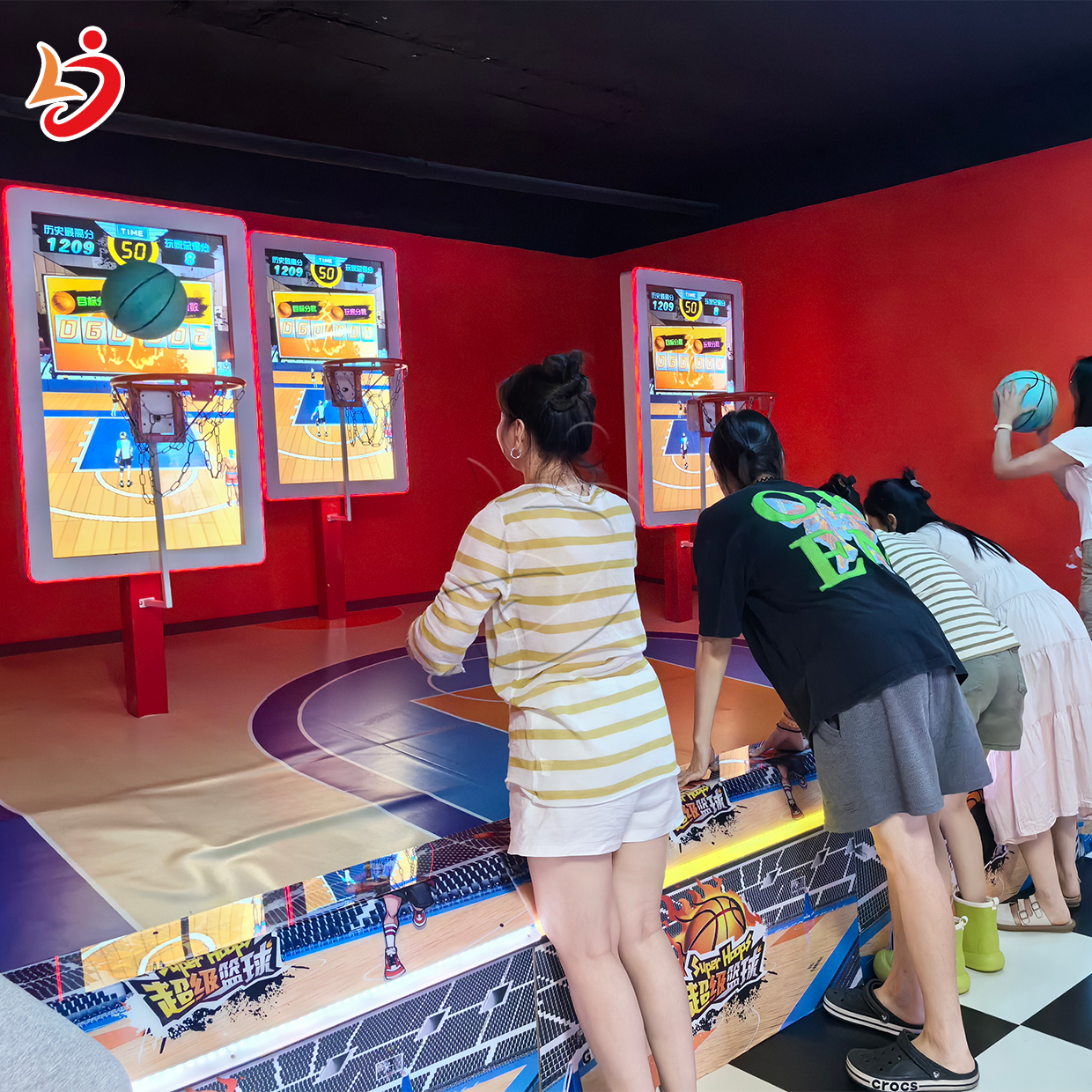
The single-player setup is obsolete for high-traffic zones. From a floor-plan perspective, it presents a terrible space-to-revenue ratio. A standard mechanical cabinet eats up square footage but monetizes only one user at a time. Transitioning to a modern setup changes the math entirely.
By utilizing a unified, wide-screen piece of FEC basketball equipment, you allow two to four people to play simultaneously within a condensed footprint. A four-player digital simulator shares internal hardware, a massive digital display, and dual ball-return mechanisms. It does not require four times the floor space of a single legacy cabinet.
Looking at recent shifts in the out-of-home entertainment sector, commercial real estate costs are forcing operators to abandon low-density attractions. The market is aggressively moving toward "competitive socializing." Modern consumers, particularly millennials and Gen Z, demand shared group experiences rather than isolated gameplay. High-throughput, multiplayer environments are now the baseline for driving sustained foot traffic. If your equipment isolates players, you are falling behind the industry curve.
Furthermore, multiplayer setups trigger a powerful "social multiplier." Single units rely on sporadic walk-ups. A multi-player bay naturally attracts groups. When a family of four approaches, they fill all available slots instantly. This completely eliminates the idle time of waiting for separate individuals to initiate a game. Group play sparks fierce competition, driving immediate rematches and organic utilization.
Optimizing an interactive basketball game requires balancing behavioral psychology with hard math. If you set the game too short—say, 30 seconds—players feel cheated. The perceived value of that card swipe drops. Guest satisfaction tanks, and repeat visits diminish.
On the other hand, if a session stretches to 3 minutes, the machine becomes a bottleneck. Stagnant lines form across your walkways. Potential customers lose patience and walk away.
Field data shows the ideal session length falls between 60 and 90 seconds during peak hours. This gives players enough time to break a sweat and feel accomplished. It ensures the attraction turns over fast enough to clear heavy queues. Modern simulators use phased gameplay to make short sessions feel packed. Instead of a boring countdown, the software splits the session into dynamic stages: 30 seconds of standard stationary shooting, followed by moving digital targets, ending with a high-value "three-point shootout." This density makes a 90-second game feel incredibly rewarding.
Digital platforms offer backend flexibility that mechanical games lack. You are not locked into a rigid timer. During a busy Saturday shift, you access the configuration menu and drop the session time to 60 seconds. This maximizes turnover when foot traffic peaks. Conversely, on a slow Tuesday afternoon, you extend it to 120 seconds. With no lines waiting, extending the game boosts perceived value for the guests in the building, keeping them engaged longer.
To grasp the financial impact of throughput, you must look at objective math. Guesswork ruins financial projections. Calculating your venue capacity requires a standard formula.
The Throughput Formula:
(60 minutes / Total Session Cycle in minutes) × Number of Active Players × Utilization Rate = Hourly Throughput
Note: The "Total Session Cycle" must include an estimated 15 to 20 seconds for payment processing, physical movement, and player transition.
Let us look at a real-world comparison between two different setups.
Scenario A: The Traditional Setup
A venue uses a standard single-player cabinet. It is mechanically paced. The average session time (including coin insertion and physical ball return delays) takes roughly 3 minutes.
Equation: (60 / 3) × 1 Player × 0.75 (75% Utilization) = 15 paying players per hour.
Scenario B: The Multiplayer Upgrade
The venue replaces the legacy cabinet with a 4-player digital basketball simulator. Using smart software settings, the operator sets the session length to a fast-paced 1.5 minutes.
Equation: (60 / 1.5) × 4 Players × 0.75 (75% Utilization) = 120 paying players per hour.
Metric | Legacy Single-Player Arcade | 4-Player Digital Simulator |
|---|---|---|
Max Player Capacity | 1 Player | 4 Players |
Session Duration | 3.0 Minutes | 1.5 Minutes |
Hourly Game Cycles | 20 Cycles | 40 Cycles |
Peak Hourly Throughput (75% Utilization) | 15 Players / Hour | 120 Players / Hour |
Estimated Hourly Revenue (At $2.00 / Play) | $30.00 / Hour | $240.00 / Hour |
The mathematical conclusion is undeniable. By adjusting player density and session time, the venue increases its hourly throughput by 800%. You fundamentally change the revenue potential of that specific floor space.
When analyzing floor efficiency, you must understand the hardware limitations of older models. Traditional units rely on heavy metal rims, physical rubber basketballs, and mechanical scoring arms. These physical parts create inherent latency. Balls get stuck. Mechanical relays fail to register a swish. Staff must intervene with an "Out of Order" sign. Every minute waiting for a technician is lost money.
Specifically, upgrading from an outdated basketball arcade machine to a modern system bypasses these physical bottlenecks. Advanced optical sensors and high-definition screens register scores instantly. More importantly, turnover is frictionless. When the timer hits zero, the software resets the environment immediately. There is no waiting for physical balls to roll down a ramp. The next group swipes their cards and starts in three seconds.
In addition, digital setups drive replayability without requiring players to re-queue. They feature global leaderboards and immediate "Rematch" prompts on the screen. When four friends finish a tight match, the interface flashes the final scores and offers a one-tap rematch. This keeps the machine generating revenue and kills transition downtime.
Achieving maximum throughput requires commercial-grade engineering. You need hardware and software built to shave seconds off every user interaction. Here is what to look for when selecting equipment.
Even in a digital environment, the physical throw is central. Premium systems use steeply sloped, optimized return matrices. This ensures the ball feeds directly back to the player's hands instantly. By eliminating the dead time of chasing stray balls, you can confidently shorten the timer to 60 seconds without frustrating the player.
The payment phase is a massive source of hidden downtime. Token jams are unacceptable. Your hardware must feature integrated RFID card readers and NFC tap-to-pay terminals. When a group of four steps up, they sequentially tap their venue cards in under five seconds. This shaves massive delays off every cycle.
Optimization requires actionable data. Advanced simulators provide real-time telemetry via backend dashboards. You track metrics like "Average Session Player Count" and "Peak Utilization." With objective data, you make on-the-fly adjustments to maintain optimal capacity based on actual traffic, not guesswork.
A high-capacity machine will underperform if placed in a dead zone. Strategic placement creates natural funnels that feed players into the queue. Your goal is a near 100% utilization rate during peak hours.
Do not hide a high-throughput attraction in the back corner. These machines process massive volume and need heavy foot traffic. Position the simulator near the main entrance as a visual draw. Place it next to the food and beverage area where large groups socialize.
Furthermore, top FECs use a "Sports Zone" strategy. Instead of scattering sports games, they group interactive simulators together. Placing digital hoops next to a virtual golf bay creates a high-energy crowd. This triggers social proof. As players finish one game, they step into the adjacent queue, keeping machines constantly active.
Maximizing floor space revenue is a mix of operational math and strategic foresight. Traditional mechanical games suffer from physical bottlenecks and low capacity. A modern digital simulator blends high-density player counts with rapid, adjustable pacing. This eliminates frustrating downtime and encourages highly lucrative group play. By upgrading your hardware, you shorten wait lines, elevate guest satisfaction, and see a measurable surge in daily profitability.
For maximum throughput during peak operational hours, a session time of 60 to 90 seconds is highly recommended. This duration keeps the action fast-paced and ensures rapid queue turnover. During off-peak times, operators can extend the timer to 120 seconds to offer better perceived value when line management is not a concern.
While slightly wider than a single physical cabinet, a 2-to-4 player digital setup is incredibly space-efficient. It processes up to four times the number of active players in roughly 1.5 times the physical footprint. This drastically improves your revenue generated per square foot.
Yes. Modern interactive sports games feature secure operator menus. Venue managers can easily log into the backend software to customize session times, adjust difficulty levels, and change ticket payout ratios based on real-time traffic patterns.
Digital simulators rely on optical sensors and solid-state screens rather than moving mechanical hoops. This technological shift means there is significantly less mechanical wear and tear. The reduction in moving parts translates to lower maintenance costs and minimized downtime.
Depending on your venue's foot traffic, operators typically see a full return on investment within 3 to 6 months. This rapid ROI is driven by the 4x multiplier in player capacity and the drastic reduction in maintenance-related downtime.
Absolutely. The integration of high-definition graphics, competitive leaderboards, and adjustable difficulty levels makes them highly engaging for adult demographics. They are currently a major revenue driver in barcades and competitive socializing venues.
Ready to eliminate bottlenecks and multiply your hourly revenue? Now is the time to evaluate your current layout and optimize your venue for maximum financial return. Explore the full range of high-throughput commercial solutions at LJ Sports Tech and find the perfect multiplayer configuration for your facility's unique floor plan.
