


Views: 0 Author: Site Editor Publish Time: 2026-09-23 Origin: Site


Pickleball is booming worldwide. Unpredictable weather and early sunsets, however, frequently disrupt outdoor matches. As the sport matures, technology bridges the gap, bringing the action indoors. A well-engineered indoor pickleball simulator serves as the ultimate year-round training and entertainment solution.
Golf simulators are relatively static. Pickleball is not. This dynamic racquet sport demands explosive lateral movement, sudden forward lunges, and aggressive overhead smashes. A poorly designed bay ruins the experience. It leads to cramped footwork, inaccurate sensor readings, and severe safety hazards. Proper spatial planning solves these issues. It creates an immersive, data-rich environment that replicates the authentic feel of a real hardcourt.
Below is an engineering-level breakdown of how width, depth, and vertical clearance directly impact system playability, hardware accuracy, and user safety.
Width Dictates Biomechanics: A minimum width of 12 to 15 feet is non-negotiable. It safely accommodates lateral dinks and wide cross-court drives without player hesitation.
Depth Controls Tracking Accuracy: A depth of 16 to 20 feet guarantees the correct screen-to-player distance. This provides high-speed optical sensors enough flight time to calculate ball speed, spin decay, and launch angle.
Clearance Prevents Damage: Ceiling heights of 10 to 12 feet are mandatory. Anything lower restricts full-extension overhead smashes and risks shattering expensive paddles.
Commercial Viability: Precision sizing maximizes ROI. It ensures safety, protects hardware, and allows the bay to seamlessly switch between multiple sports.
Why are indoor simulation venues exploding in popularity? The answer lies in urban infrastructure and weather constraints. Recently, strict local noise ordinances have forced many outdoor pickleball courts to shut down. Simultaneously, players are actively seeking climate-controlled environments to escape extreme summer heat and winter freezes.
Consequently, the market is pivoting rapidly toward high-tech indoor solutions. We are witnessing a transition from casual park play to data-driven athletic training. Facility owners now realize that dedicating 880 square feet to a single traditional court is highly inefficient. Instead, they are integrating compact, revenue-generating bays that utilize advanced tracking technology to maximize yield per square foot.
In any racquet sport, lateral movement is the foundational biomechanical requirement. Players constantly shuffle side-to-side to cover the non-volley zone (the "kitchen"). Picture a player rushing the net. They need to lunge wide for a sharp cross-court dink. If the structural bay is too narrow, hesitation kicks in. The natural flow of the game is instantly destroyed.
From an installation perspective, width requirements break down into three tiers:
Absolute Minimum (12 Feet / 3.6m): Suitable only for static drilling and center-line practice. Lateral movement is severely restricted.
Standard/Recommended (15 Feet / 4.5m): Allows for natural lateral lunges. This is the sweet spot for most residential and standard commercial setups.
Premium/Multiplayer (16 - 18+ Feet / 4.8m+): Provides a comprehensive sports simulator experience. It easily accommodates wider passing shots and alternating multiplayer modes.
Safety remains the primary driver behind these width recommendations. When reacting to a fast-paced virtual shot, human reflex takes over. In a constrained space, a player lunging outward will inevitably strike a side enclosure. High-end carbon fiber paddles are substantial investments; hitting a rigid drywall or steel frame will fracture the paddle's core instantly. A 15-foot width creates a necessary buffer zone between maximum reach and the physical walls.
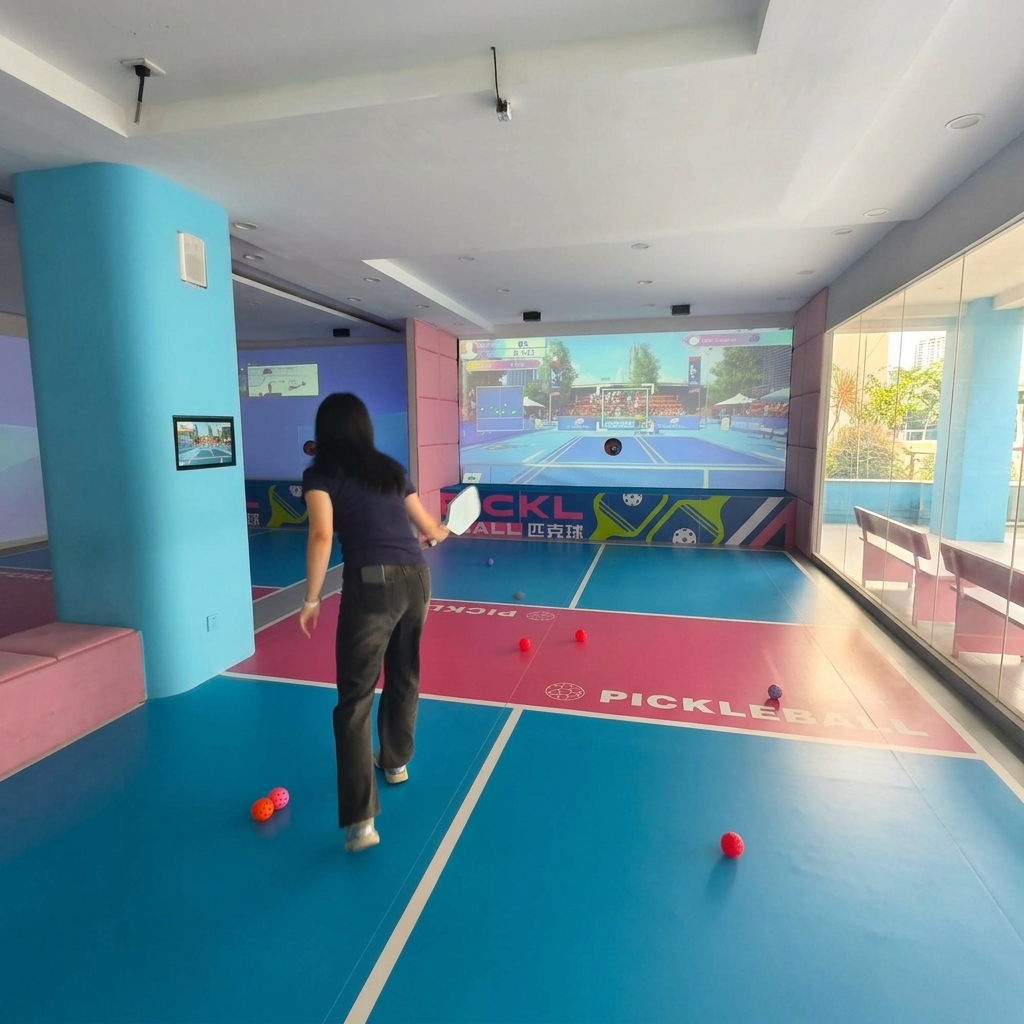
Moving from lateral space to longitudinal requirements, depth is arguably the most critical dimension for sensor accuracy. Industry standards dictate a total bay depth of 16 to 20 feet. Within this footprint, the distance between the player's hitting position (the virtual baseline) and the impact screen must be meticulously calculated.
How does depth affect hardware? Modern simulator systems, such as the advanced dual-camera vision setups found in premium equipment, require a minimum of 10 to 12 feet of physical ball flight. The cameras need this specific window to capture enough data frames. If a user stands too close to the screen, the system cannot record enough of the wiffle ball's trajectory to accurately calculate its unique spin axis and aerodynamic drag. Conversely, standing too far back risks casting shadows on the projection or hitting the rear wall during a deep backswing.
Furthermore, proper depth management mitigates "bounce-back" hazards. A pickleball retains significant kinetic energy. When it strikes a tightly tensioned polyester screen, it rebounds. A screen-to-player distance of 10 to 12 feet provides the necessary runway for the ball to lose momentum and drop safely to the floor.
Standard residential ceilings typically measure 8 to 9 feet. For racquet sport simulators, this is fundamentally inadequate. Placing an athlete in a low-ceiling environment triggers "indoor swing syndrome." This is a subconscious biomechanical flaw where the player shortens their swing arc—tucking their elbow or ducking their head—to avoid hitting the ceiling. Over time, this degrades real-world mechanics.
Consider the math behind an overhead smash:
Player Height: An average adult male stands roughly 6 feet tall.
Arm Extension: A fully extended upward arm adds 2 to 2.5 feet.
Paddle Length: A standard elongated paddle measures up to 16.5 inches (1.37 feet).
Vertical Leap: A dynamic smash involves a vertical jump of 6 to 12 inches.
Adding these metrics together, a player's maximum vertical reach easily exceeds 10 feet. Therefore, a ceiling height of 10 to 12 feet is the established engineering standard.
High ceilings also shield sensitive hardware. Defensive lobs feature incredibly steep launch angles. Without adequate vertical clearance, these shots will strike overhead projectors or lighting rigs. Professional installations utilize angled ceiling baffles to absorb high-arcing shots and protect the technology above.
To simplify the planning phase, here is a practical reference table mapping bay dimensions to specific use cases and hardware requirements. This ensures your physical space aligns with the technical capabilities of professional-grade systems.
Bay Tier | Dimensions (W x D x H) | Hardware & Sensor Compatibility | Best Use Case |
|---|---|---|---|
Entry / Compact | 12' x 16' x 10' | Basic floor-mounted radar, short-throw projectors. | Residential garages, single-player static drills. |
Standard Commercial | 15' x 18' x 11' | Overhead high-speed dual-camera systems, multi-sport software. | Sports bars, dedicated training centers, advanced coaching. |
Premium / FEC | 18' x 20'+ x 12' | Commercial-grade tracking, integrated kiosk, automated ball return. | High-traffic entertainment venues, alternating multiplayer. |
When engineering a commercial sports simulator for a Family Entertainment Center (FEC) or country club, designers must prioritize high-traffic durability and accessibility. Commercial bays generally err on the larger side, often measuring 16+ feet wide and over 20 feet deep.
This additional space is legally necessary for ADA (Americans with Disabilities Act) compliance, ensuring standard wheelchair turning radiuses. Commercial setups also require an extra 5 to 10 feet of depth behind the hitting area. This accommodates spectator seating, waiting players, and operational kiosks. Enclosures in these environments rely on rugged, commercial-grade padding and reinforced steel framing to withstand continuous daily impacts.
In contrast, homeowners installing a system in a garage or basement face strict spatial constraints. If a room is only 13 feet wide, installers often utilize an offset hitting configuration. By shifting the software's center line slightly to one side, players gain more room for their dominant-hand swings. For residential setups, prioritizing ceiling height over width is heavily recommended. Retractable netting can also replace rigid padded walls, allowing a garage to function as a simulator bay by day and vehicle storage by night.
The flooring of a racquet sport simulator differs entirely from a golf setup. Golf bays utilize synthetic turf. However, a wiffle ball dropped on artificial turf absorbs the kinetic energy, resulting in a dead bounce. To properly simulate an authentic court, the flooring must be a specialized hardcourt surface.
Industry-standard solutions include interlocking polypropylene modular tiles or heavy-duty PVC sports vinyl. These materials offer essential shock absorption to protect player joints during aggressive lateral stops. More importantly, they provide the exact coefficient of friction needed to replicate an outdoor acrylic court.
The impact screen acts as the focal point of the bay. It must balance two competing physics requirements: tight weaving for crisp 4K image projection, and extreme durability to withstand repeated impacts from a polymer ball traveling over 60 mph. Poly-blend screens with a multi-layer spacer mesh are the optimal choice. To complement the screen, side-barrier netting or padded panels catch errant mis-hits, keeping the ball contained and ensuring an uninterrupted interactive pickleball game.
One of the most compelling arguments for optimizing bay dimensions is the crossover potential with other activities. The spatial requirements for a premium racquet sport setup perfectly overlap with the specifications for a high-end indoor golf simulator. By designing the bay to these robust specifications, operators ensure the space is not limited to a single demographic.
Modern tracking hardware is highly adaptable. Through integrated software platforms, a single bay seamlessly transitions from a competitive racquet match to a full 18-hole golf simulation, or even arcade-style games. For operators investing in FEC sports equipment, this multi-sport versatility transforms the bay into a universally appealing asset. It maximizes hourly rental rates, extends customer dwell times, and ensures consistent utilization regardless of seasonal sports trends.
A successful indoor facility relies entirely on precise bay design. Proper width guarantees realistic, dynamic lateral movement. Adequate depth ensures highly accurate optical sensor tracking. High vertical clearance allows for safe, uninhibited overhead swings, protecting both the player's mechanics and the facility's hardware.
Whether you are outfitting a high-traffic entertainment center or building a private training oasis, adhering to these dimensional guidelines is the key to an immersive, authentic experience. Evaluate your space, match it with commercial-grade tracking technology, and take the first step toward year-round, climate-controlled playability. For tailored hardware solutions and multi-sport simulator systems, consult with professional manufacturers like LJSportsTech to build your custom bay today.
The absolute minimum functional size for a bay is 12 feet wide, 16 feet deep, and 10 feet high. This width provides just enough space for a single player to execute standard baseline shots. The 16-foot depth allows for a safe distance between the player and the impact screen, ensuring the tracking sensors have enough time to capture the ball's flight path. The 10-foot ceiling is non-negotiable for adults, as it prevents paddle damage during standard overhead smashes.
True side-by-side doubles play requires a significantly wider bay, typically exceeding 20 feet, to ensure players do not strike each other during simultaneous dynamic movements. Because of sensor limitations and physical footprint constraints, most simulator software is engineered for singles practice or targeted drills. However, players can simulate a doubles match using alternating turn-based multiplayer modes, keeping the physical footprint manageable while remaining highly competitive.
Spin tracking accuracy depends heavily on the bay's depth and the quality of the camera sensors. High-speed dual-camera systems require at least 10 to 12 feet of ball flight to capture enough frames to analyze the wiffle ball's holes and calculate spin decay. If the bay is too shallow (under 15 feet total depth), the cameras lack the necessary flight time, resulting in estimated rather than measured spin data. Proper depth ensures 98%+ accuracy on spin and launch angles.
Yes, but it requires specific modifications. The physical dimensions of a standard commercial golf bay (15'W x 20'D x 10'H) are perfect for racquet sports. However, you must change the flooring. Golf turf causes a dead bounce for plastic balls, so a hardcourt overlay or interlocking sports tiles must be installed over the hitting area. Additionally, the tracking hardware and software must be upgraded to a multi-sport vision system capable of reading the aerodynamics of a perforated polymer ball.
Yes, specialized flooring is a strict requirement. Artificial turf absorbs the impact of a plastic wiffle ball, preventing it from bouncing naturally and ruining the simulation physics. Furthermore, the lateral lunges and sudden stops required in racquet sports demand a surface with a specific coefficient of friction. Interlocking modular sports tiles or heavy-duty vinyl hardcourt surfaces are necessary to mimic a real court, provide proper shoe grip, and prevent slip-related injuries.
