


Views: 0 Author: Site Editor Publish Time: 2026-09-30 Origin: Site


Ever hit a perfect top-corner shot, feeling the satisfying thud of your boot against the leather, only for the screen to show a frustrating miss or a delayed response? It is a scenario we see all too often in poorly calibrated indoor setups. Bad sensor placement ruins practice sessions. It transforms what should be a rigorous training routine into an irritating arcade game.
A true indoor training environment requires precise optical and infrared synergy. In this comprehensive guide, we will break down exactly how camera angles and sensor placement dictate system accuracy. By understanding the physics behind the hardware, facility owners and players can choose the right setup for their specific space.
Key Takeaways:
Precision Requires Synergy: The most accurate setups combine high-speed optical cameras with strategically placed infrared sensors to eliminate blind spots.
Camera Angle is Everything: Overhead and side-angle camera placements drastically alter how launch angle and ball spin are calculated. Improper angles lead to delayed or skewed data.
Infrared Dictates Speed: An infrared grid is the gold standard for instantly capturing initial ball velocity and strike impact with near-zero latency.
Environment Matters: Even the best setups suffer from data inaccuracies if room lighting or physical space constraints interfere with sensor calibration.
Data Drives Improvement: Accurate tracking of ball speed, launch angle, and spin rate transforms a basic game into a professional training tool.
When evaluating indoor sports technology, buyers must draw a hard line between systems designed for casual amusement and those engineered for athletic development. The core differentiator? Uncompromising data accuracy.
Recent market analyses indicate a definitive paradigm shift within the sports technology sector. Facility owners are rapidly abandoning legacy, estimation-based arcade systems in favor of hyper-accurate, biomechanical simulation platforms. This trend is driven by an increasingly sophisticated consumer base—ranging from youth academies to amateur enthusiasts—who demand empirical feedback over mere gamification. Modern players want to know their exact spin rate, not just see a generic animation. Arcade-style setups prioritize user engagement over physical reality, often relying on basic algorithms that guess where a ball might go based on a single point of impact.
In contrast, a premium setup functions as a professional diagnostic tool. For facility owners, investing in exact physics measurement is no longer an optional upgrade; it is the baseline industry standard required to retain serious clientele.
Flawed shot tracking actively harms a player's development. If a digital soccer simulator suffers from latency or miscalculates the spin rate, players will subconsciously alter their natural kicking mechanics to compensate for the machine's errors. For example, if a system consistently registers a lower launch angle than what was actually struck, a player might begin leaning back unnaturally to force the ball higher on the screen. When they transition back to a physical pitch, these acquired bad habits will severely degrade their real-world performance. Reliable data forms the bedrock of constructive practice.
To understand system accuracy, we must look under the hood. Modern simulators do not simply "watch" the ball. They capture thousands of data points in milliseconds using specialized hardware arrays.
High-speed optical cameras map the visual flight path of the ball. Operating at frame rates often exceeding 200 to 1,000 frames per second (FPS), these lenses capture rapid, sequential images as the ball leaves the player's foot. The system's software analyzes the changing size and position of the ball across these frames to stitch together a three-dimensional shot trajectory tracking model. Furthermore, high-resolution lenses identify specific patterns on the ball's surface to calculate exact rotation and spin axis.
While cameras provide visual mapping, infrared technology delivers mathematical certainty regarding speed and location. These systems utilize emitters and receivers to project an invisible grid across the strike zone. When a physical object passes through this space, it breaks the infrared beams. By measuring the exact microsecond the beams are broken, the system calculates initial velocity with absolute precision.
In high-end commercial systems, these two technologies communicate seamlessly. Continuous high-speed camera recording requires massive processing power and can lead to software lag. To solve this, the infrared hardware acts as a physical trigger. The moment the player's foot strikes the ball and breaks the first infrared beam, a signal is sent to the optical cameras to begin capturing frames. This synchronization ensures the cameras only record the exact moments of impact, optimizing processing speed and keeping latency under 0.1 seconds.
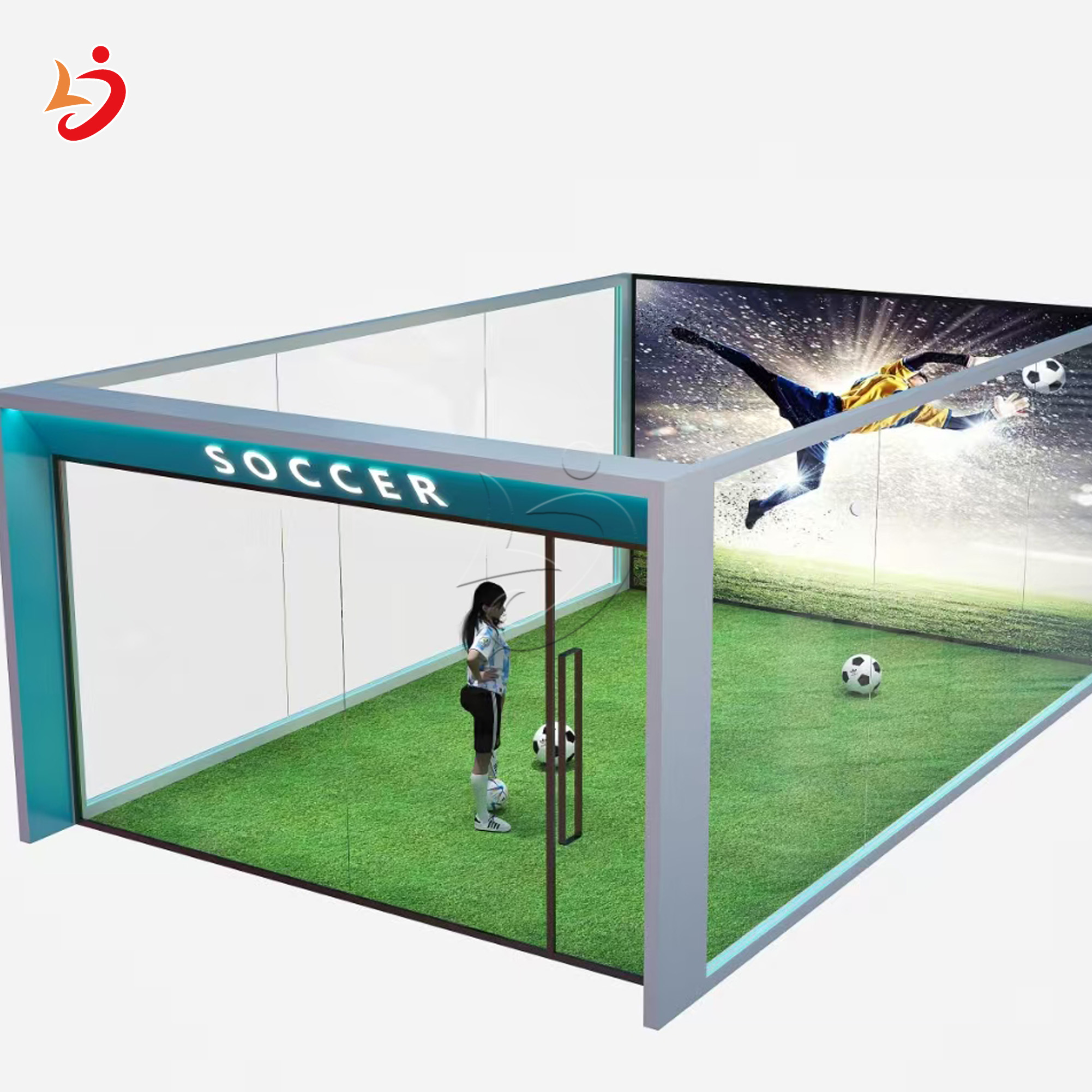
The physical placement of optical lenses fundamentally changes how data is interpreted. A camera can only measure what it can clearly see. Therefore, viewing angles are a critical factor in any football simulator installation.
Different camera angles serve distinct analytical purposes. Overhead camera placements are structurally optimal for capturing the horizontal direction (yaw) and the overall spin axis. Because the camera looks down from the ceiling, its field of view is rarely obstructed by the player's body. This angle excels at mapping the lateral movement required to simulate a bending free-kick.
Conversely, floor-level or side-mounted cameras capture the exact launch angle (pitch) and the precise foot-to-ball impact point. A side-profile view allows the software to measure immediate vertical acceleration. Systems relying solely on one angle often struggle to render a complete three-dimensional flight path, forcing the software to guess rather than measure.
A critical flaw in poorly designed setups is player occlusion. As a player steps into a heavy shot and follows through, their leg or torso can temporarily block a single camera's line of sight. If the camera loses visual contact during the first few milliseconds of flight, the resulting data is compromised. To mitigate these blind spots, premium setups utilize multi-camera stereoscopic configurations placed at offset angles. This ensures that if one lens is blocked, the secondary camera maintains an uninterrupted visual lock.
While optical cameras excel at reading spin and trajectory, they are inherently limited by frame rates and processing time. To capture instantaneous velocity without screen lag, systems rely on a robust infrared foundation.
An infrared sports sensor operates by emitting invisible light curtains across the hitting area. The placement of this grid relative to the ball's starting position is paramount. If the sensor array is positioned too close to the ball, it may only capture the player's foot. If it is placed too far away, the system misses the initial acceleration phase. Optimal placement creates a dedicated strike zone that isolates the ball's movement immediately after separation from the boot.
The primary advantage of infrared technology is its speed. Unlike cameras, which must capture a frame, send it to a processor, and analyze pixel displacement, an infrared sensor registers a broken beam at the speed of light. By measuring the microsecond difference between when the ball breaks the first and second infrared planes, the system calculates raw ball speed instantaneously. This completely eliminates the dreaded screen lag.
To provide actionable feedback for players and coaches, a high-quality machine must accurately isolate specific physical metrics. It calculates precise physics based on strict performance criteria.
Ball speed is the foundational metric, indicating the raw power generated by the player. Proper infrared placement ensures the initial burst of kinetic energy is captured accurately, right before indoor air resistance begins to slow the ball down. Launch angle determines whether a shot is a low grounder or a top-corner strike. Without precise launch angle data, a delicate chip shot might incorrectly register as a driven ground pass.
Perhaps the most complex metric to capture is spin rate. High-speed cameras must read the physical pattern on the leather to calculate backspin, topspin, or side-spin. This data is absolutely crucial for replicating bending free-kicks. If the system cannot read the spin axis accurately, the virtual ball will not curve around the digital wall.
Performance Metric | Primary Hardware Dependency | Why It Matters for Training | Acceptable Error Margin |
|---|---|---|---|
Ball Velocity | Infrared Sensor Grid | Measures raw striking power and energy transfer. | ± 1.0 mph |
Vertical Launch Angle | Side/Floor-Level Camera | Differentiates between ground passes and aerial chips. | ± 0.5 degrees |
Horizontal Direction | Overhead Camera | Tracks shot accuracy relative to the target line. | ± 0.5 degrees |
Spin Axis / Curve | High-Speed Optical Camera | Required for replicating bending shots and aerodynamics. | ± 50 RPM |
When evaluating the market, buyers frequently encounter systems marketed as purely "camera-only" or "infrared-only." However, relying entirely on one isolated technology introduces significant performance limitations.
Systems relying exclusively on optical cameras are heavily dependent on environmental lighting. If the room is too dark, or if there is flickering from cheap fluorescent bulbs, the cameras will drop frames. Additionally, processing high-resolution video in real-time requires immense computing power, naturally introducing processing lag between the physical strike and the digital response.
Conversely, systems that rely entirely on infrared sensors excel at speed but fail at visual nuance. An infrared beam cannot "see" the surface of the ball. Therefore, it cannot accurately measure spin rate or the exact axis of rotation. An infrared-only setup will struggle to simulate a shot that relies heavily on aerodynamic curve.
The most accurate and reliable systems on the market utilize a hybrid approach. By merging both technologies, top-tier setups eliminate the weaknesses of each individual component. This synergy is what transforms a basic indoor game into a professional-grade AR soccer training machine, providing the empirical data required by coaches and serious athletes.
Even the most technologically advanced system will generate flawed data if the physical room is improperly prepared. Facility owners must account for spatial and environmental factors before installation to prevent hardware failure.
Optical cameras require consistent, flicker-free illumination to maintain high frame rates. Flickering LEDs or older fluorescent tubes cause "strobing" in the camera feed, leading to dropped frames and missed spin data. Furthermore, natural sunlight pouring through a window contains high levels of infrared radiation. This natural IR light will blind the system's sensors, causing them to miss the ball entirely. Controlled, even indoor lighting is absolutely mandatory.
Physics dictates that sensors need time and space to read a moving object. If the designated strike zone is positioned too close to the impact screen, the ball will hit the canvas before the cameras have captured enough frames to calculate spin. While specifications vary, a standard minimum distance of 3 to 4 meters (roughly 10 to 13 feet) between the ball placement and the screen is generally required to ensure flawless data capture.
Precision hardware requires a precise foundation. If the floor of the facility has a slight slope or uneven concrete beneath the turf, the calibration of floor-mounted sensors and side-angle cameras will be fundamentally misaligned. A physical slope of just one degree translates into massive trajectory errors in the digital software.
A reliable indoor training space is only as valuable as the data it collects. Achieving true-to-life precision requires a sophisticated interplay between hardware components. Camera angles are strictly responsible for determining the visual flight path, launch angles, and complex spin rates. Meanwhile, precise infrared placement guarantees instantaneous velocity readings and zero-latency triggers.
For commercial facility owners and serious athletes seeking a reliable solution, prioritizing systems that utilize dual-tracking hybrid technology is essential. By ensuring correct sensor placement, optimal camera angles, and a controlled indoor environment, you secure a system that provides genuine athletic improvement. Ready to upgrade your facility with industry-leading accuracy? Explore the professional-grade simulation hardware at LJ Sportstech to find the exact configuration tailored to your commercial or residential needs.
When high-speed cameras and infrared sensors are placed at the correct angles and calibrated properly, modern commercial simulators can achieve over 98% accuracy. They are capable of replicating ball speed, spin rates, and trajectory with an error margin of less than one degree compared to real-world physical measurements.
Yes, natural sunlight causes severe operational issues. Direct sunlight contains high levels of natural infrared light, which effectively "blinds" the artificial infrared receivers used in the hardware. To maintain data integrity, it is highly recommended to install your system in a controlled indoor environment equipped with consistent, non-flickering LED lighting.
Absolutely. Capturing the complex aerodynamics of a bending free-kick requires precise visual data. Overhead cameras are specifically required to accurately read the side-spin and the resulting horizontal deviation. Floor-level cameras alone may miss the rotational axis data entirely, resulting in a shot that flies straight instead of curving.
An AR (Augmented Reality) training machine blends physical ball striking with interactive, gamified digital environments. Despite the different software applications, professional AR machines rely on the exact same underlying hardware—high-speed cameras and infrared sensor grids—to seamlessly and accurately merge the physical ball's flight with the digital world.
While specific requirements vary based on the manufacturer's lens focal lengths, you generally need a minimum of 10 to 13 feet (3 to 4 meters) of physical distance from the strike zone to the impact screen. This distance provides the cameras and sensors with the necessary milliseconds to capture the ball's full flight data before impact.
For optimal overhead camera placement and unrestricted player movement, a minimum ceiling height of 10 feet (3 meters) is recommended. This allows enough clearance for high-arcing chips and ensures overhead sensors can capture a wide enough field of view without distortion.
Latency is the delay between the physical ball striking the screen and the virtual ball appearing in the software. High latency (over 0.2 seconds) breaks immersion and frustrates players, making the system feel like a cheap video game. Premium systems use infrared triggers to keep latency under 0.1 seconds, providing an instantaneous, true-to-life response.
