


Views: 0 Author: Site Editor Publish Time: 2026-10-20 Origin: Site


Constructing a traditional shooting facility demands a massive influx of capital, complex zoning permits, and substantial land acquisition. For many event organizers, business owners, and local clubs, building from scratch is simply out of the question. A persistent roadblock often halts the enthusiasm of competitive athletes and weekend hobbyists eager to learn this skill: finding a safe, dedicated space to shoot.
Fortunately, an innovative solution is transforming the landscape. A Movable Archery Range offers a versatile, cost-effective alternative that completely bypasses the headaches of fixed construction. Whether you are an event planner looking to spice up a corporate retreat, a camp director managing seasonal youth programs, or a homeowner craving a temporary backyard practice area, mobile solutions are revolutionizing how we access the sport.
Looking at recent commercial real estate data and entertainment industry shifts, operators are increasingly pivoting away from static locations. The current market shows a strong preference for agile, pop-up activations. These setups capitalize on high-foot-traffic events without the crushing burden of a multi-year commercial lease. This macroeconomic trend makes mobile sporting environments a highly strategic and resilient business asset, rather than just a recreational novelty.
Flexibility & Convenience: Establish a safe, fully functional shooting environment almost anywhere. Transition smoothly from outdoor grassy fields to indoor corporate banquet halls.
Cost-Effective Operations: Eliminate the prohibitive construction, leasing, and maintenance costs typically associated with permanent brick-and-mortar facilities.
High Commercial Potential: Utilize mobile setups as a scalable, high-ROI business model for event rentals, community festivals, and seasonal summer camps.
Tech-Friendly Integration: Modern portable environments seamlessly pair with digital simulators for gamified, highly interactive user experiences.
Uncompromising Safety: Portable ranges strictly adhere to established industry safety standards when implemented with commercial-grade backstops and safety netting.
A movable archery range is a fully functional, temporary shooting environment engineered for rapid assembly, disassembly, and transportation. Unlike fixed locations that require poured concrete or long-term commercial leases, a mobile system relies on modular engineering. This adaptability allows operators to pack the entire experience into a standard commercial vehicle. You bring the sport directly to the participants instead of forcing them to travel to a dedicated facility.
To function effectively while maintaining rigorous safety standards, a portable setup relies on specialized equipment designed for both mobility and durability. From an engineering perspective, every component must withstand repeated kinetic impact and environmental exposure.
Portable Target Stands: Lightweight yet structurally stable frames. These are often constructed from extruded aluminum or reinforced polymers, designed to hold targets securely across uneven outdoor terrains.
High-Density Foam Targets: Weather-resistant blocks capable of stopping fast-moving arrows through sheer friction. This allows for safe impact dissipation and effortless arrow retrieval.
Modular Safety Netting: Heavy-duty, tightly woven synthetic mesh, like Kevlar or high-impact nylon. This acts as the primary arrow catcher behind the targets.
Boundary Markers: High-visibility ropes, cones, or floor tape used to clearly define shooting lines, waiting areas, and lateral safety buffer zones.
Determining the right time to invest in a mobile solution depends heavily on your operational context. The following scenarios highlight situations where a temporary configuration significantly outshines a permanent installation.
Local fairs, farmers' markets, and holiday festivals thrive on interactive entertainment. A Portable Range naturally draws curious crowds and stands out from standard carnival games. Operators can erect a modular setup on grass or asphalt within a few hours. Organizers generate direct revenue by charging per round of arrows while maintaining a compact footprint that fits perfectly within standard vendor spaces.
Organizations have strict guidelines for archery instruction. Yet, many seasonal summer camps operate on leased land where permanent construction is strictly prohibited. Temporary ranges allow camp directors to offer certified programs during the summer months. The equipment is packed away into storage during the off-season. This prevents weather degradation and frees up the field for other athletic activities.
Corporate event planners constantly seek novel experiences to foster team cohesion. Transporting a team of executives to an off-site facility requires logistical planning, bus rentals, and extended time away from the primary venue. Bringing a mobile setup directly to a hotel lawn maximizes participation time. Facilitators can seamlessly integrate shooting exercises into the schedule between seminars.
Maintaining a consistent practice schedule can be incredibly difficult for competitive shooters living in regions with harsh winters. A temporary system allows archers to convert a rented school gymnasium, a local warehouse, or even a large residential garage into a functional indoor practice space. Once the outdoor weather improves, the equipment is disassembled, returning the space to its original purpose.
The rise of experiential entertainment has birthed a lucrative new business model: the mobile target practice provider. Entrepreneurs purchase a complete portable setup, including inflatable bunkers and foam-tipped arrows. They rent their services out for birthday parties and neighborhood block events. Traveling directly to the client drastically reduces overhead costs, making it an exceptionally high-ROI venture.
Stakeholders must carefully weigh the benefits of mobility against the stability of a fixed location when allocating capital. A permanent facility requires securing a long-term lease or purchasing expensive land. These spaces must meet specific architectural requirements, including clear span areas without structural pillars and high ceilings.
In stark contrast, a movable range requires absolutely zero permanent footprint. It adapts dynamically to the space available. You can deploy it in a 50-yard outdoor field today and a 20-yard indoor exhibition hall tomorrow. The financial barrier to entry is arguably the most significant differentiator. Building a permanent Indoor Archery Range involves massive capital expenditure for specialized HVAC ventilation systems, permanent structural backstops, and complex zoning permits.
Operational Feature | Mobile / Portable Range | Permanent Facility |
|---|---|---|
Initial Capital Investment | Low to Moderate. Primarily equipment costs. | Extremely High. Land, construction, HVAC, permits. |
Setup & Deployment Time | Under 60 minutes for a standard commercial kit. | Months to years for full construction and zoning approval. |
Real Estate Footprint | Zero permanent footprint. Storable in a standard garage. | Requires dedicated, large-scale commercial real estate. |
Customer Acquisition | Proactive. You bring the experience to existing crowds. | Reactive. Customers must travel to your specific destination. |
As sensor technology advances, the traditional paper-target experience is evolving rapidly. Integrating digital solutions with portable setups is a logical and highly profitable next step for operators looking to provide a premium experience.
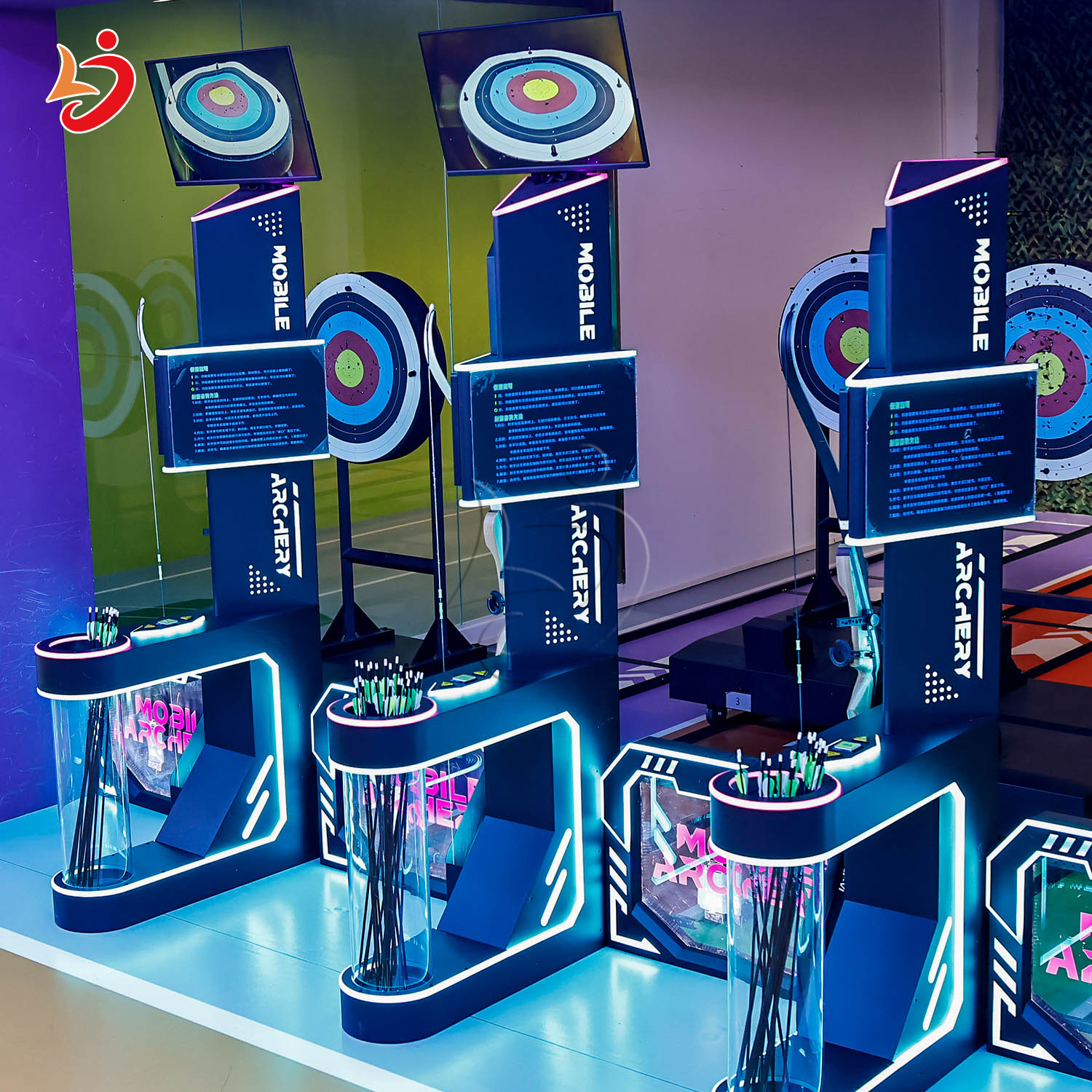
An Archery Simulator is an interactive digital system that replaces static foam blocks with a specialized, impact-resistant projection screen. Using high-lumen projectors and advanced optical sensors, the system displays virtual targets, moving wildlife, or engaging arcade-style games. When an archer fires a blunt-tipped arrow into the screen, the sensors instantly calculate the trajectory and point of impact. The system displays the result on the digital interface in real-time with zero latency.
Pairing a simulator with a mobile enclosure creates an immersive attraction perfectly suited for trade shows or high-end corporate parties. Archers remain highly engaged even at much shorter shooting distances, typically just 10 to 15 yards. A portable light-blocking tent houses the simulator to ensure the projector image remains crisp even in bright environments.
The most common hesitation regarding temporary setups is safety. Stakeholders often wonder if a mobile environment can adequately protect participants and bystanders. It is crucial to understand that temporary does not equate to unsafe. These ranges meet rigorous industry safety standards when engineered and deployed correctly.
Safety begins with strict spatial planning. While the shooting distance varies based on skill level, the safety buffer zones are non-negotiable. There must be a minimum of 10 to 15 yards of clear, unoccupied space directly behind the primary backstop netting. This accounts for the rare event of a pass-through. Lateral safety zones must be cordoned off to prevent bystanders from wandering into the line of fire.
The structural integrity of a portable setup relies heavily on its backstop system. Operators must invest in commercial-grade arrow netting specifically rated for the draw weights of the bows being used. A critical engineering rule: netting should never be pulled taut. It must be hung with enough slack, draped like a heavy curtain, to dissipate the kinetic energy of the arrow upon impact. This allows the arrow to drop harmlessly to the floor.
Physical barriers are only half of the safety equation. Active crowd control is equally vital. Operators establish clear visual boundaries using ropes or physical barricades. The range must feature a clearly marked shooting line where archers stand. A strict waiting line must be situated at least 5 yards behind the shooters to keep non-participants out of harm's way.
Deploying a mobile range requires a methodical approach to ensure operational efficiency. Follow this practical engineering criteria to select and establish your temporary shooting environment.
Before unpacking a single piece of equipment, evaluate the chosen location. For outdoor venues, look for flat, even ground to ensure target stands do not wobble. Ensure the shooting direction does not face the sun. Never set up a range facing a parking lot, pedestrian walkway, or glass windows. For indoor setups, verify that the ceiling height provides adequate clearance for the arc of the bow.
An effective Archery Setup requires matching the target material density to the kinetic energy of the equipment. Bag targets are ideal for lightweight recurve bows, offering effortless arrow removal. Layered foam targets are mandatory if participants use higher-poundage compound bows. The dense foam stops fast-moving arrows effectively through friction.
A physical setup is useless without strict operational commands. The designated Range Master must enforce clear protocols before anyone handles a bow. Standardized whistle commands are highly recommended. Two blasts to step up to the line, one blast to nock arrows and begin shooting, and three blasts to stop shooting and retrieve arrows. No one crosses the shooting line until the clear signal is given.
Evaluating the return on investment reveals strong financial viability for commercial operators and private individuals alike. The initial capital outlay for a complete, professional-grade portable kit is relatively low. Business owners often recoup their initial equipment investment within the first few weekend festival appearances or private party rentals by charging premium rates.
For private individuals or scouting organizations, the investment is measured in cost-avoidance. Purchasing a portable system allows these groups to completely bypass expensive hourly range fees or monthly club memberships. It eliminates the travel time associated with driving to a distant facility. Because commercial-grade portable equipment is built for extreme durability, target stands and safety nets maintain a strong resale value on the secondary market.
A movable setup makes perfect sense when flexibility, cost-savings, and space constraints dictate your operational strategy. By eliminating the need for permanent construction and long-term leases, this practical solution successfully removes traditional barriers to entry. It allows operators to bring the action directly to the community, creating engaging, safe, and highly profitable experiences.
Ready to deploy a high-ROI shooting environment? Evaluate your site dimensions and operational goals, then source commercial-grade equipment to guarantee safety and durability. Visit LJ Sports Tech to configure your ideal mobile setup today and start capitalizing on the booming experiential entertainment market.
Yes, absolutely. As long as you have adequate ceiling height to accommodate the draw arc of the bow, proper lighting, and heavy-duty safety netting to protect walls and windows, it works perfectly. When configured correctly with appropriate backstops, a mobile setup serves as an excellent temporary indoor practice space for seasonal training or specialized corporate events.
Space requirements depend heavily on the skill levels of the archers and the types of bows being used. For beginners and youth camps, a physical shooting distance of 10 to 15 yards is generally sufficient. However, you must factor in an additional 10 to 15 yards of clear, unoccupied safety buffer zone directly behind the targets to ensure complete safety in the event of a missed shot.
Yes, they are highly secure when managed correctly. By pairing the activity with lightweight beginner bows or foam-tipped arrows for combat-style games, the risk is heavily mitigated. Supporting the environment with a proper setup featuring commercial safety nets ensures these configurations are widely and safely utilized by established youth organizations.
The cost varies significantly based on the scale and technology integrated. A basic setup with lightweight target stands, standard foam targets, and entry-level safety netting can start around a few hundred to a thousand dollars. However, premium commercial kits featuring high-impact Kevlar netting, modular aluminum frames, and integrated digital simulator screens will require a larger investment, though they offer a substantially higher ROI for rental businesses.
Permit requirements depend entirely on your local municipal zoning laws and the specific venue. If you are operating on private property for personal use, permits are rarely required. However, if you are setting up a commercial pay-to-play range at a public park, festival, or corporate event, you will likely need a temporary vendor permit and proof of commercial liability insurance. Always consult local authorities before deploying a commercial setup.
