


Views: 0 Author: Site Editor Publish Time: 2026-08-17 Origin: Site


Commercial training facilities face severe operational friction when advanced simulation hardware relies on disconnected or manual scoring systems. Fragmented user experiences occur when players must manually input data or wait for delayed system responses. Without unified digital scoring, operators cannot host scalable leagues, implement digital wallets, or provide seamless gamification. This disconnect directly lowers user retention and limits revenue potential. The technical solution requires integrating real-time data capture—using high-speed cameras, dual-radar setups, and optical sensors—with centralized scoring software via robust APIs. By bridging physical action and digital tracking, operators transform a standalone bay into a fully integrated digital sports simulator ecosystem. The architecture demands precise synchronization between hardware telemetry and software processing to maintain the illusion of reality.
API Interoperability is the Bottleneck: Successful integration relies on open API architecture that allows hardware sensors to communicate seamlessly with third-party scoring, digital wallets, and league management software.
Latency Dictates User Experience: Real-time scoring requires sub-second data processing from the moment of impact to screen display; high latency destroys the illusion of simulation.
Hardware-Agnostic Software Prevents Lock-in: Choosing scoring platforms that integrate with multiple tracking technologies (optical, radar, infrared) ensures long-term scalability across different sports.
Environmental Calibration and Dynamic Lies are Non-Negotiable: Lighting, physical space, moving lies, and hydraulic simulator platforms directly impact sensor accuracy, requiring rigorous initial setup and ongoing calibration protocols.
Establishing a successful integration requires defining strict technical success criteria. A fully optimized system demands zero manual input from the user during active gameplay. Latency must remain strictly under 500 milliseconds from the moment of physical impact to the digital screen display. The architecture must maintain 99% uptime during peak commercial hours to prevent workflow disruptions. Achieving these metrics relies on a deep understanding of how hardware and software layers interact within the simulation environment. You must configure the network to handle high-frequency data packets without dropping frames or lagging the physics engine.
The hardware layer serves as the foundation for physical telemetry capture. High-speed cameras, photometric sensors, and dual-radar systems work in tandem to record raw data. These devices measure impact metrics such as swing speed, ball spin, launch angle, and predictive shot destination. The hardware must capture thousands of frames per second to ensure no physical data points are lost during high-velocity movements. We typically see camera systems operating at 2000 to 3000 frames per second to accurately read the spin axis of a fast-moving object.
The software layer acts as the processing engine. Middleware receives the raw telemetry from the hardware sensors via UDP or TCP protocols and translates it into actionable scoring metrics. This involves complex algorithms that calculate points, strikes, or goals based on the specific rules of the active game. The middleware then pushes this processed data to the user interface in real time, updating leaderboards and individual player profiles without noticeable delay. If the middleware is poorly optimized, even the best hardware will feel sluggish to the user.
Integration Layer | Primary Function | Key Technologies | Performance Metric |
|---|---|---|---|
Hardware Telemetry | Raw physical data capture | High-speed cameras, dual-radar, photometric sensors | Frame rate (>2000 fps), spatial accuracy (mm) |
Middleware Processing | Data translation and physics calculation | Physics engines, API gateways, calibration algorithms | Processing speed (<100ms), packet loss rate |
Software Interface | User interaction and scoring display | Graphic engines, digital wallets, league dashboards | Render latency (<500ms), system uptime |
Comparing the reliability of optical tracking versus radar reveals distinct advantages depending on the indoor environment. Optical tracking excels in capturing initial launch data and spin rates, making it highly effective for short-distance precision. Optical systems require strictly controlled lighting conditions to function accurately. Ambient sunlight or flickering fluorescent bulbs will corrupt the data feed. Radar systems are superior at tracking long-distance flight paths and remain unaffected by ambient light. The physical space available dictates the hardware selection. Radar requires more depth behind and in front of the player to track the object's trajectory effectively, often needing at least 15 to 20 feet of total room depth.
The scoring architecture must fluidly switch between different phases of play. The system must transition from high-velocity tracking during powerful shot phases to micro-movement precision tracking for short games or putting. Ensuring seamless data continuity as a player moves from the initiation to the completion of a single game-cycle prevents tracking dropouts. You must configure the sensor array to hand off tracking responsibilities. For example, a radar unit tracks the initial 10 feet of flight, while an overhead optical sensor takes over for the final approach to the target.
Initialize the primary tracking sensor based on the selected game mode.
Establish a baseline calibration grid for the physical hitting area.
Configure the middleware to listen for specific telemetry triggers (e.g., impact sound or sudden velocity spikes).
Map the handoff protocols between radar and optical sensors for multi-phase tracking.
Test the end-to-end data loop to verify sub-500ms render times on the display screen.
Different sports demand unique tracking methodologies and scoring algorithms. A uniform approach fails when dealing with the diverse physics of various athletic movements. The integration must adapt to the specific size, speed, and trajectory of the object being tracked. You cannot use a golf tracking algorithm to accurately score a soccer penalty kick.
Integrating scoring into a digital soccer simulator requires highly specialized metrics. The system must accurately measure ball velocity, trajectory, and strike zone accuracy in a fraction of a second. Tracking a larger, deformable object like a soccer ball presents unique challenges. The ball compresses upon impact, altering its initial flight characteristics. The software must map this flight path to virtual goalkeeper AI and dynamic target zones. Advanced setups incorporate biometric swing and kick analysis algorithms. These algorithms translate the player's physical kick mechanics into performance scoring, offering feedback on technique alongside standard point allocation. The camera array must be positioned to capture the full arc of the kick without being obstructed by the player's follow-through.
An AR baseball simulator relies on the precise integration of pitch velocity, launch angle, and hit distance. The complexity increases when mapping a physical strike zone to an augmented reality overlay. This mapping must simulate an accurate umpire experience, distinguishing between balls and strikes with millimeter precision. The system architecture must handle rapid transitions between pitcher tracking and batter tracking within the exact same simulation loop. When the user throws a pitch, the radar tracks the incoming velocity. Milliseconds later, the optical sensors must activate to track the bat's path and the resulting hit trajectory. This dual-phase tracking requires immense processing power and perfectly synchronized sensor handoffs.
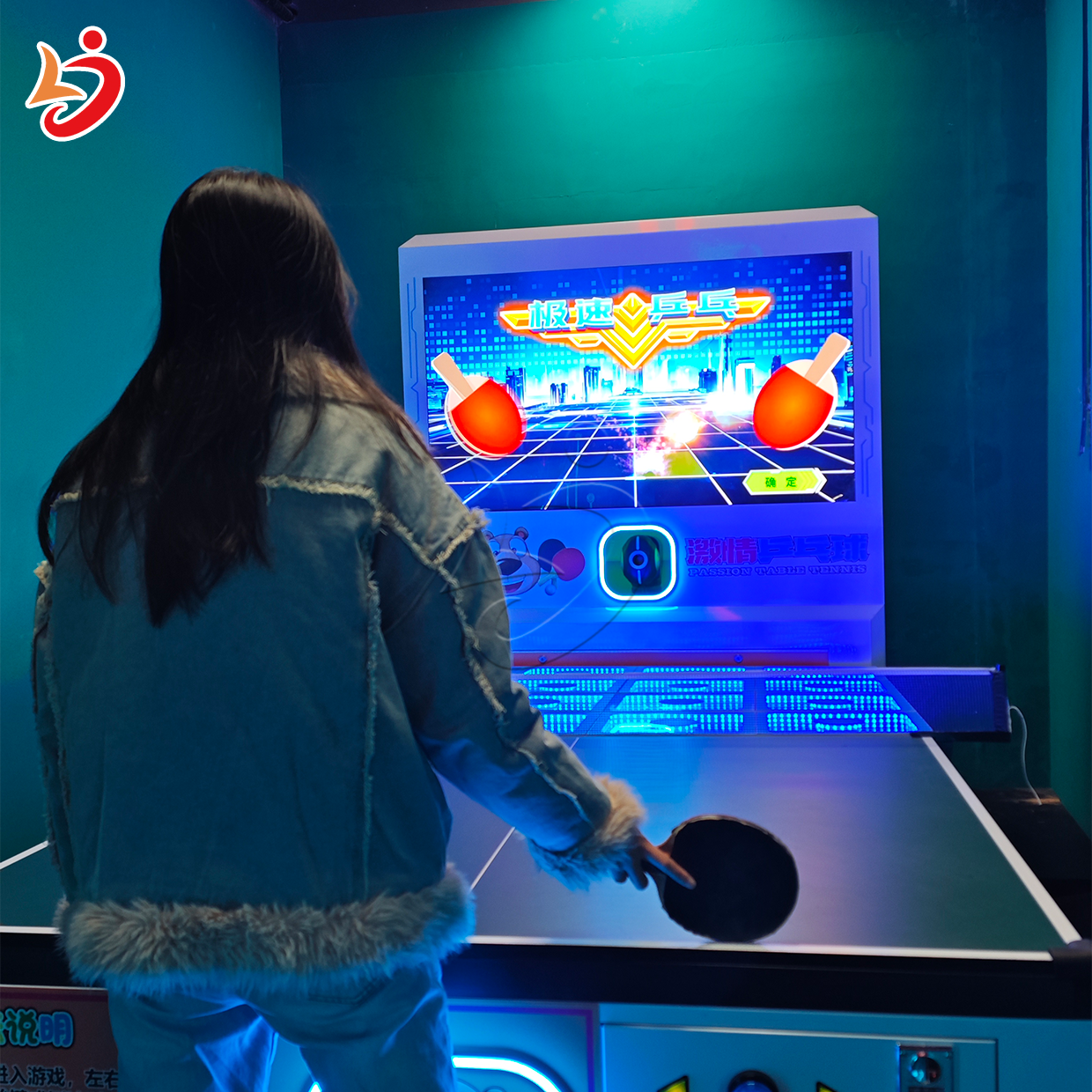
The speed of a digital table tennis simulator necessitates hyper-fast optical sensors. Tracking high-speed, short-distance rallies requires cameras capable of capturing hundreds of frames per second. Facilities must choose between table-integrated impact sensors and overhead camera arrays for automated point allocation. Spin-detection algorithms play a massive role here, as they dictate real-time trajectory adjustments and scoring accuracy. The software must instantly calculate the spin axis to determine if a ball would have legally bounced on the virtual table. Piezoelectric sensors embedded under the table surface can provide instantaneous impact data, which the middleware then cross-references with the overhead optical feed to confirm the exact location of the bounce.
A digital billiard simulator shifts the focus from high-velocity flight to complex multi-object physics. Integration involves overhead projection combined with advanced computer vision to track multiple objects simultaneously across a flat plane. The computational load is significant. The processor must calculate complex physics, including english (spin), bank angles, and multi-ball collisions, to update the scoring in real time. The visual overlay must perfectly match the physical table to maintain user immersion. If the projector is misaligned by even a few millimeters, the projected trajectory lines will not match the physical balls, completely ruining the simulation experience. We use high-contrast infrared markers on the table corners to allow the software to auto-calibrate the projection mapping continuously.
Selecting the right software architecture determines the long-term viability of the simulation bay. Operators must weigh the benefits of closed, proprietary systems against the flexibility of open API frameworks. The choice dictates how easily you can upgrade hardware or add new game modes in the future.
Closed systems offer a plug-and-play experience with high reliability. Because the hardware and software are developed together, integration issues are minimal. They suffer from strict vendor lock-in and an inability to add custom sports or third-party tracking tools. Open APIs provide the flexibility to develop custom user interfaces and integrate multi-vendor hardware. This allows for a highly tailored experience but requires dedicated development resources and introduces higher initial setup complexity. You must write custom middleware to translate the raw hexadecimal data from a third-party radar into the JSON format required by your scoring engine.
Ecosystem Type | Primary Advantage | Primary Disadvantage | Best Use Case |
|---|---|---|---|
Closed / Proprietary | Guaranteed stability and vendor support | Strict hardware lock-in | Standardized commercial entertainment venues |
Open API Architecture | Hardware agnostic, highly customizable | Requires in-house development and testing | High-end training facilities needing specialized metrics |
Hybrid Middleware | Balances custom UI with stable core tracking | Licensing fees for API access | Multi-location franchises building custom apps |
Modern scoring systems must integrate seamlessly with point-of-sale (POS) systems and digital wallet APIs. This integration allows users to pay for bay time, enter competitive tournaments, and track lifetime statistics without visiting a front desk. By utilizing established REST protocols, facilities create a frictionless commercial gamification loop. Users load funds, play games, earn digital achievements, and spend their balances entirely within the simulator's interface. The API must handle tokenized transactions securely, ensuring that the simulator software never stores raw credit card data locally on the bay's computer.
Launching a self-managed indoor league requires robust backend infrastructure. The scoring software must handle player registration, automated bracket generation, and historical handicap calculations. For facilities with multiple locations, multi-bay synchronicity is vital. The architecture must push real-time scoring updates to a centralized cloud server, allowing players in different cities to compete on the exact same automated leaderboard simultaneously. We configure the local middleware to cache scoring data during network outages and sync with the cloud server the moment connectivity is restored, preventing any loss of tournament data.
Handling user data requires strict adherence to privacy compliance standards. Simulators capture sensitive information, including biometric tracking data, performance analysis, personal profiles, and payment gateway details. The software architecture must encrypt data both in transit and at rest. Facilities must ensure that their API integrations do not expose user data to unauthorized third-party applications. Implement OAuth 2.0 protocols for user authentication and ensure all telemetry data pushed to cloud leaderboards is anonymized unless the user explicitly opts into public profile sharing.
Deploying advanced digital scoring systems introduces several physical and technical risks. Identifying these risks early allows operators to implement effective mitigation strategies before launch. Hardware fails, networks drop packets, and physical environments shift. You must engineer the system to handle these realities gracefully.
Fluorescent lighting, reflective surfaces, or inadequate physical space frequently cause dropped frames or inaccurate data capture. Optical sensors are particularly vulnerable to ambient light pollution. Facilities must conduct pre-installation environmental audits. Implementing controlled infrared (IR) lighting setups and scheduling routine automated calibration checks ensures the sensors maintain their baseline accuracy. We mandate the installation of matte-black, non-reflective materials on the walls immediately surrounding the sensor array to eliminate IR bounce-back that confuses the cameras.
Simulators utilizing moving platforms or dynamic lies risk disrupting the baseline calibration of optical or radar-based sensors. When the physical floor shifts, the sensor's understanding of the horizon is compromised. The solution involves integrating gyroscopic spatial feedback from the moving platform directly into the tracking software. This allows the system to dynamically adjust sensor baselines in real time, compensating for the physical movement of the hitting surface. The API must accept continuous pitch and roll data from the platform's motors to offset the tracking matrix.
Firmware updates from hardware manufacturers can inadvertently break API connections with third-party scoring software. This leads to unexpected downtime and frustrated users. Facilities should utilize middleware backed by active developer support. Establishing staging environments allows technical teams to test hardware updates thoroughly before rolling them out to the facility-wide deployment. Never push a vendor firmware update to your commercial bays without running a full 18-hole or 90-minute simulation test on a dedicated staging machine first.
High wear-and-tear on physical impact screens and sensors degrades scoring accuracy over time. A stretched screen alters the bounce-back physics, confusing radar systems. Implementing a strict preventative maintenance schedule is essential. Operators should prioritize modular hardware designs where individual sensors or screen panels can be replaced independently, avoiding the need to overhaul the entire simulation bay. Re-tension the impact screen weekly and run the automated optical calibration grid sequence every morning before opening the doors.
Inspect and clean all optical camera lenses with microfiber cloths weekly.
Verify radar alignment using a physical laser level against the center of the impact screen.
Check network switch logs for dropped UDP packets between the sensors and the PC.
Update graphics drivers only after verifying compatibility with the current middleware version.
Test the digital wallet API endpoint by running a dummy transaction before peak hours.
To finalize the integration, you must execute specific operational steps.
Conduct a pilot test with a single multi-sport bay to evaluate real-world latency and tracking accuracy under heavy load.
Request and review complete API documentation from all shortlisted vendors to ensure compatibility with your existing POS systems.
Perform a rigorous site audit focusing specifically on ambient lighting conditions and spatial constraints before ordering hardware.
Establish a clear preventative maintenance schedule for screen tensioning and sensor calibration.
A: Yes, retrofitting is possible if your legacy hardware sensors output raw data compatible with modern middleware. You must verify that the original manufacturer provides open API access. Without API access, the new scoring software cannot intercept or translate the physical telemetry captured by the older sensors.
A: The industry standard for acceptable latency is strictly sub-second, ideally under 500 milliseconds. This measures the time from physical impact to the visual result appearing on the screen. Network architecture, local processing power, and efficient middleware routing heavily impact this metric.
A: Multi-sport systems utilize software profiling. A single hardware array captures raw physical data, but the middleware switches its processing algorithms based on the selected sport. The software applies different physics engines and scoring logic depending on whether a golf ball or a baseball is detected.
A: No. While many vendors offer built-in solutions, modern simulators use REST APIs to integrate third-party payment gateways. This allows you to connect your existing facility POS system directly to the simulator's league management software.
A: Ambient light significantly impacts photometric cameras. Fluorescent lights or natural sunlight can cause glare, leading to dropped frames and missed tracking data. Accurate optical scoring requires strictly controlled lighting, often utilizing dedicated infrared illuminators that the cameras read without visual interference.
